
-
By Gunjan Gupta
- In Uncategorized
Summary: If your marketing feels busy but not necessarily effective, attribution is the missing piece. This blog breaks down how GA4 reads user journeys, why different attribution models matter, and how to identify what’s actually working in your funnel. From channel complexity to GA4’s data-driven modelling, you’ll learn how to turn scattered user journeys into clear insights. Be empowered to make ROI-focused decisions backed by accurate attribution. This blog gives the foundation for what genuinely fuels conversation and what doesn’t.
How Marketing Attribution Helps You Optimise Spend and Grow Your Business
Marketing today is not just about scripting ads and putting them up. Many platforms, types of devices and consumer behaviours influence marketing today. It is not uncommon to feel like you’re shooting in the dark while figuring out what really drives conversions. That’s where marketing attribution comes in. It gives you a means to track what is working and what isn’t. This helps you to make smarter decisions, not just guesses.
In this guide, we’ll cover what attribution really means, why it matters, and the different models you can choose from. We will also guide you on how you can pick the right one for your business. There will also be a list of some common challenges you’ll face, and how to use tools like Google Analytics 4 (GA4) for attribution reporting.
Key Takeaways
- Marketing attribution helps you track which marketing efforts truly drive conversions, replacing guesswork with data-backed insights.
- It connects your spending to business results, showing which channels or touchpoints drive the most leads and sales.
- The buyer journey today is multi-channel. People move between search, social, email, and devices. It makes attribution crucial for correct performance tracking.
- Attribution optimises marketing spend by directing budgets toward high-performing channels and cutting wasteful ones.
- There are two main attribution types:
- Single-touch models (credit one interaction)
- Multi-touch models (credit multiple interactions)
- Ten popular attribution models include:
- First-Touch
- Last-Touch
- Lead-Conversion Touch
- Linear
- Time-Decay
- U-Shaped (Position-Based)
- Custom/Algorithmic
- Rules-Based
- W-Shaped
- Data-Driven
- Each model has its ideal use case. No single model works for all businesses. The right choice depends on your goals the quality of data, and sales cycles.
- To choose the right model, you mustunderstand your customer journey, list your goals, ensure proper tracking, and test different models regularly.
- Common attribution challenges may include poor tracking, cross-device behaviour, siloed data, a lack of resources,and mismatched KPIs between teams.
- GA4 and similar tools let you compare different attribution models and see how credit changes across channels. This helps to adjust your strategies.
- Good data quality is essential. No model or tool can fix broken or incomplete tracking.
- Attribution is a process, not a one-time setup. Start simple, then you can refine over time. You should work to align your model with your evolving marketing efforts.
- The goal is actionable insight, not perfection. Use attribution to make better investment and optimisation decisions that lead to smarter growth.
What is Marketing Attribution
Marketing attribution is the method of assigning credit to the different marketing interactions (ads, emails, blog posts, social media, webinars, etc.) that lead a person to convert.
Put simply: you spend time, money and effort on many channels. At the end of the day, you want to know: which of those did the heavy lifting? Which pushed the person to buy, sign up, or take some action? That’s what attribution helps you find out.
Without attribution, you’re relying on hunches. With attribution, you connect your spending to actual business results.
But the catch is: many organisations either don’t do attribution at all, or rely on overly simplistic models that ignore most of the journey.
Why Marketing Attribution Matters More Than Ever in 2026
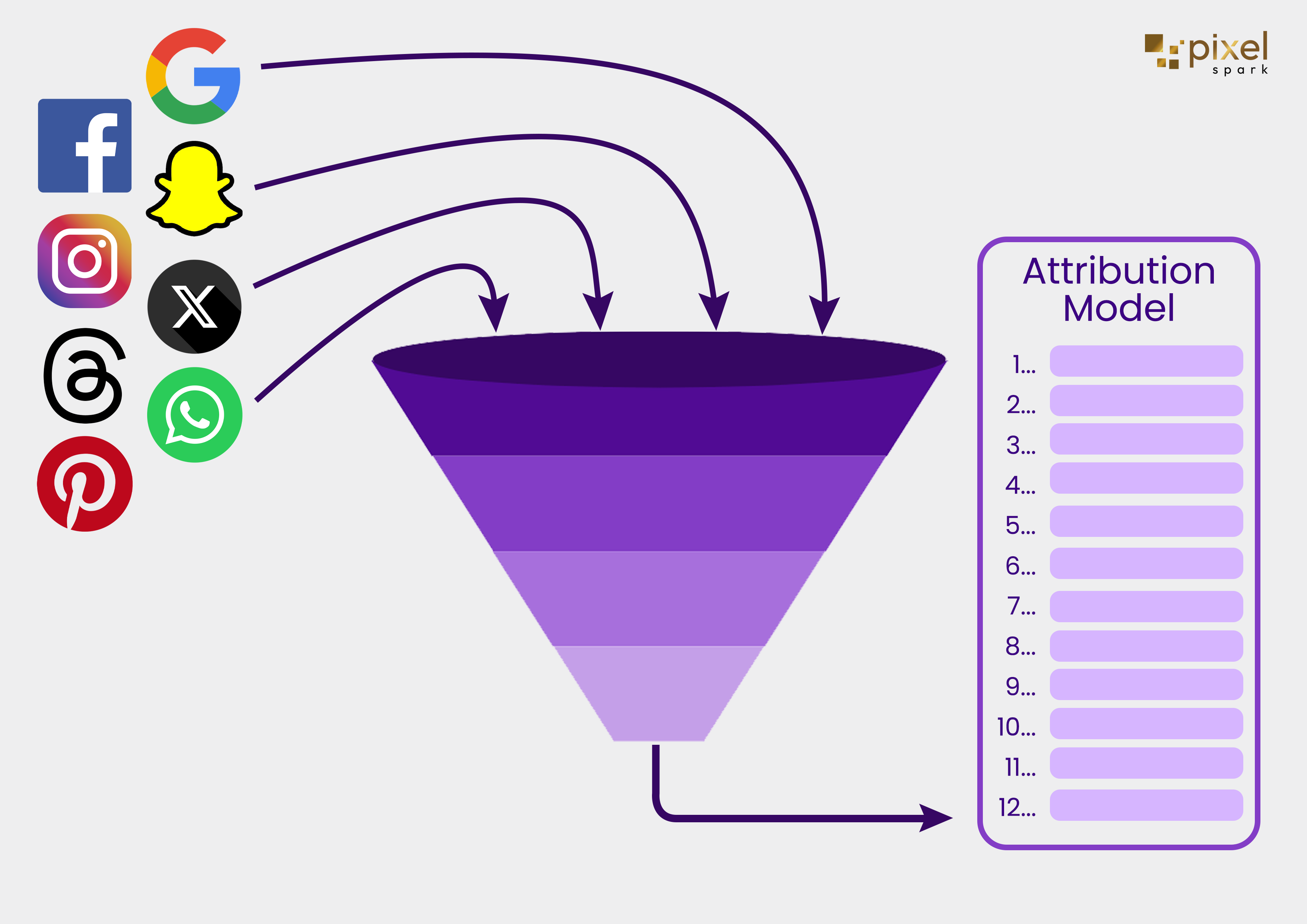
Attribution matters because the buyer journey isn’t one straight line any more. Customers move across search, social, email, and mobile devices, sometimes offline, then back online. Without a system for attribution, you may think one channel is doing great when, in fact, it’s just appearing at the end of a journey someone started in another channel.
In addition:
- It allows you to optimise your marketing spend. Put money where it’s actually driving value, cut where it’s not.
- It helps different teams, including marketing, sales, and leadership, to figure out how to convert their efforts into revenue. That shifts marketing from an investment to a tool for growth.
- It becomes more critical as tracking gets harder (for example, due to reduced cookies, privacy rules) and as cross-device behaviour rises.
Types of Marketing Attribution Models: The Top Models You Can Use Today
There’s no one-size-fits-all model. Which model you choose depends on how your customers behave, how long your sales cycle is, and how many channels you use. The models are of two big types – single-touch (one interaction gets full credit) and multi-touch (several interactions share the credit).
Here are ten common models, with details on how they work, how to use them, and their drawbacks.
1. First-Touch Attribution
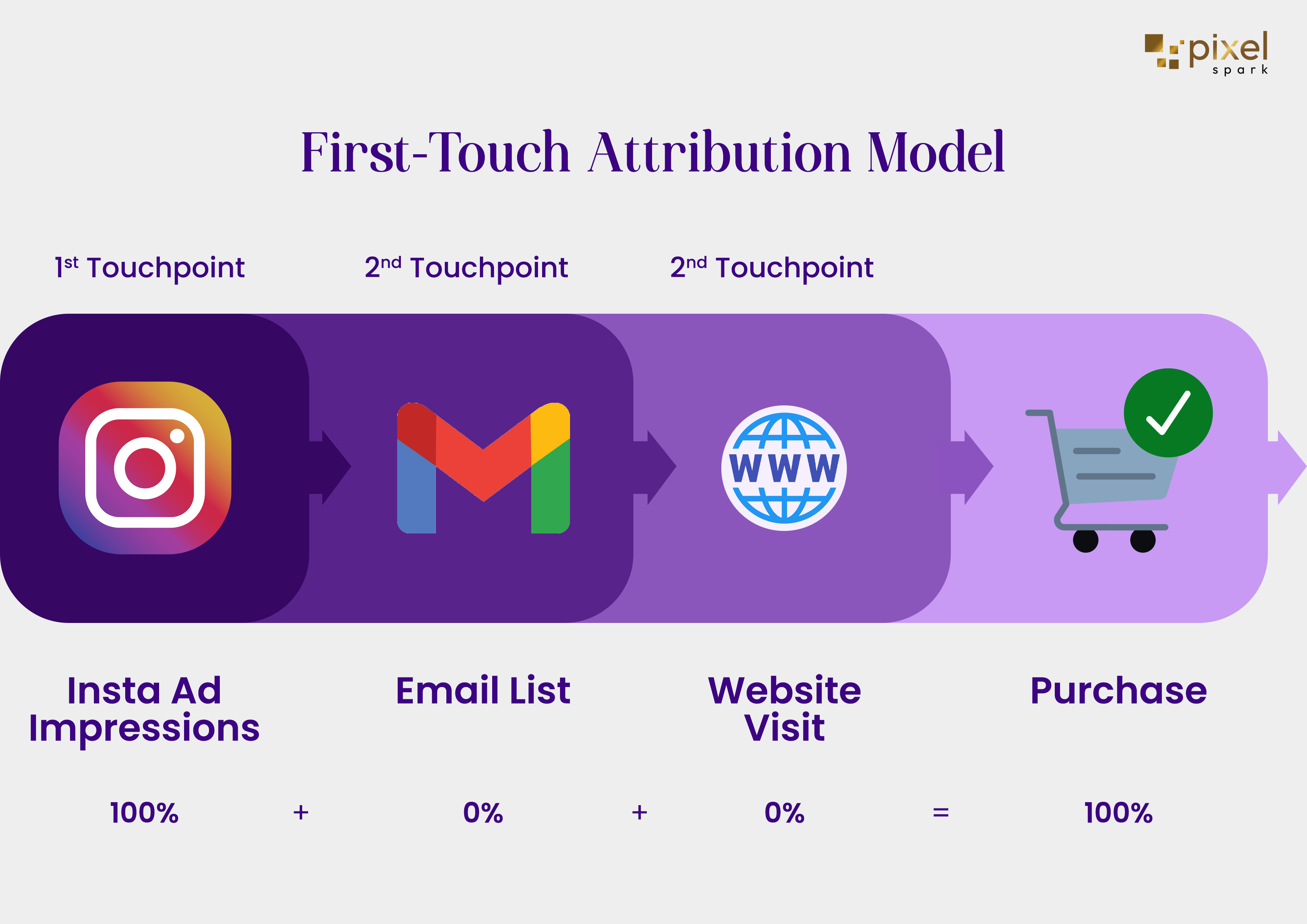
The first-touch attribution model gives all the credit for a conversion to the very first interaction that brought a visitor to your website. This is true even if the visitor didn’t buy anything or sign up for an email list right away.
Focus: Initial Connection
- This model is entirely about the beginning of the customer journey. It is the initial steps someone takes to discover and visit your site for the first time.
- It is most useful for marketers focused on demand generation and collecting leads (like through sign-up forms).
- The goal is to clearly see which actions or channels are driving that initial connection with your brand.
The Good News and The Catch
- A big advantage of the first-touch model is that it’s fairly easy to set up using tools like Google Analytics.
- However, its major drawback is that it only looks at that single initial touchpoint. This often leads to over-prioritising one channel that might not be the most important overall.
- For example, the initial social media ad that drove traffic is key for an advertiser or brand marketer.
- But, it’s not very helpful for people analysing bottom-of-the-funnel conversions, the actions that directly result in a sale or other final conversion.
- Since this model does not reveal what actually convinced the customer to buy, it limits your ability to optimise your entire marketing strategy effectively.
2. Last-Touch Attribution
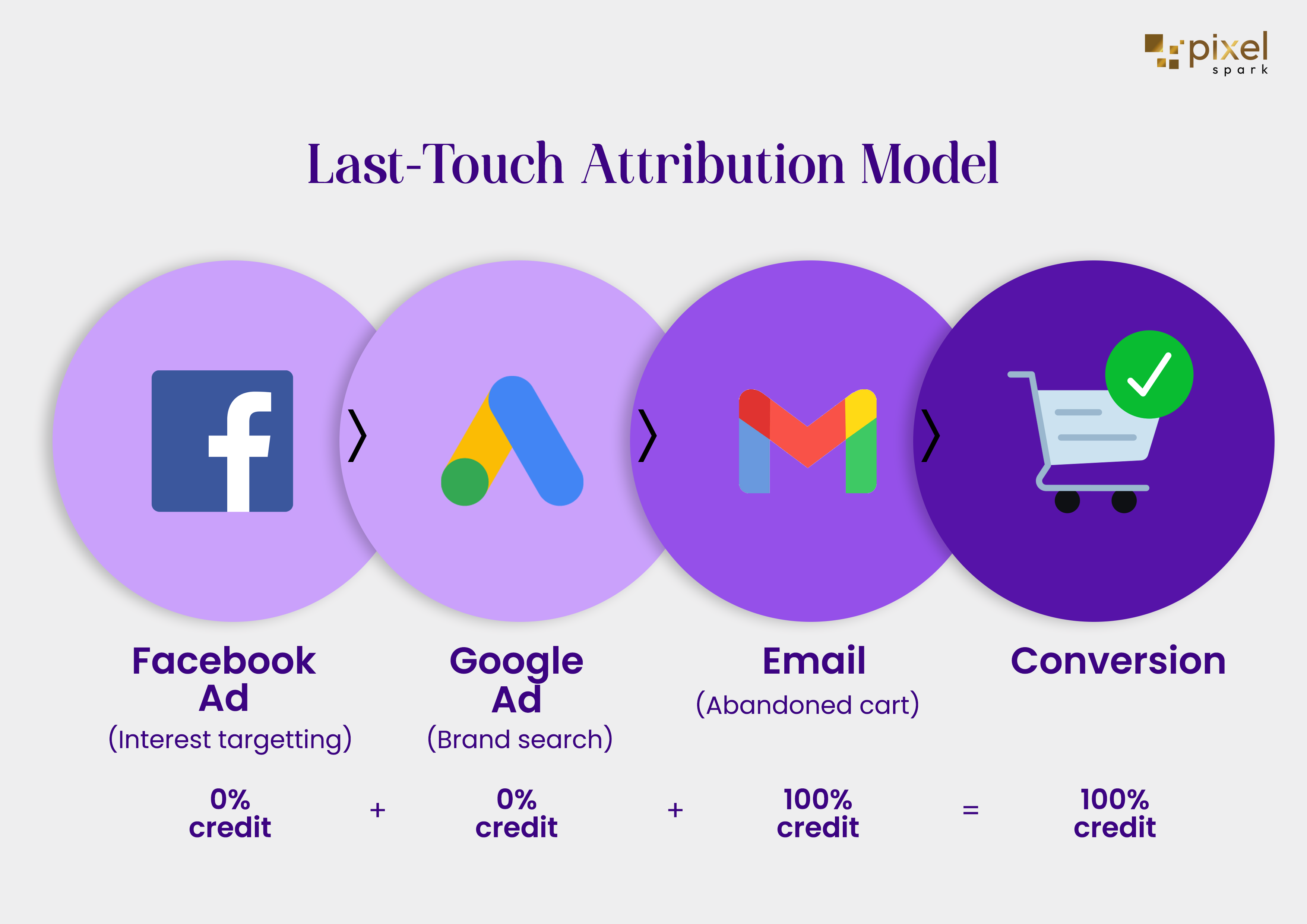
The last-touch attribution model is the complete opposite of the first-touch model. It’s often the default choice for many marketers.
Focus: The Final Step
- This model assigns all of the credit for a sale or conversion to the very last interaction a customer had before they purchased. For example, a customer might interact with your brand five times, but if they click a retargeting ad and then buy, the last-touch model credits only that final ad.
- This approach puts all the focus on the very end of the customer journey, when the purchase decision is being finalised.
The Good News and The Catch
- The last-touch model is excellent for products or services with short sales cycles.
- It’s ideal for marketing teams who are heavily focused on conversion (getting the final sale).
- The major drawback is that it completely ignores every previous factor that influenced the customer’s journey to purchase.
- By focusing only on the final interaction, you miss out on understanding the channels that created initial awareness or nurtured the customer along the way.
Bonus: Google Analytics Tip
- If you are using Google Analytics, try looking at the Last Non-Direct Click model instead of standard Last Touch.
· This alternative skips direct visits (like someone typing your URL) and highlights the last true marketing channel that drove the final purchasee
3. Lead-Conversion Touch Attribution
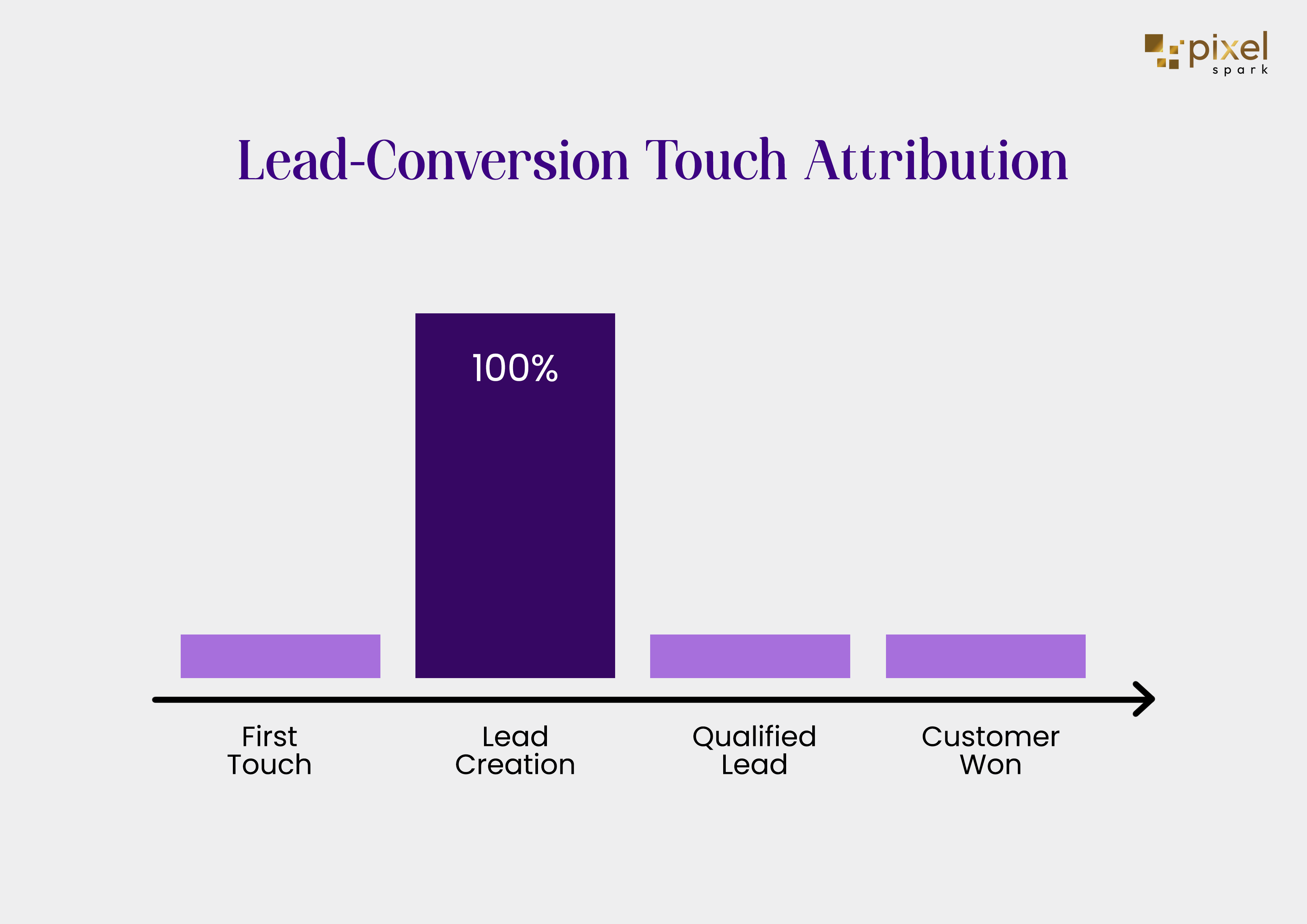
The lead-conversion touch attribution model assigns 100% of the credit for a conversion to the single interaction that first generated a lead.
Focus: Lead Generation
- This model is popular in B2B (business-to-business) companies and businesses focused on lead generation.
- It provides a clear signal: which specific campaign, offer, or web page successfully caused a visitor to convert into a lead (for instance, by filling out a form).
- It’s useful for understanding what sparks initial interest and is great for optimising for Marketing Qualified Leads (MQLs) or Sales Qualified Leads (SQLs).
The Good News and The Catch
- This model is comprehensive and offers clarity.
- Like all single-touch models, it only focuses on one moment in a longer customer journey.
- It completely misses the role of:
o Earlier awareness-building efforts (like social media or content marketing).
o Any post-lead nurturing activities that help close the final deal.
- If you use this model alone, there is a risk of over-prioritising the top-performing lead channels at the expense of important brand-building or customer retention tactics.
Bonus: Best Practice
- This model works best when it’s used alongside other attribution models that track movement through the sales pipeline or measure final sales conversions. It shouldn’t be your only source of truth.
4. Linear Attribution
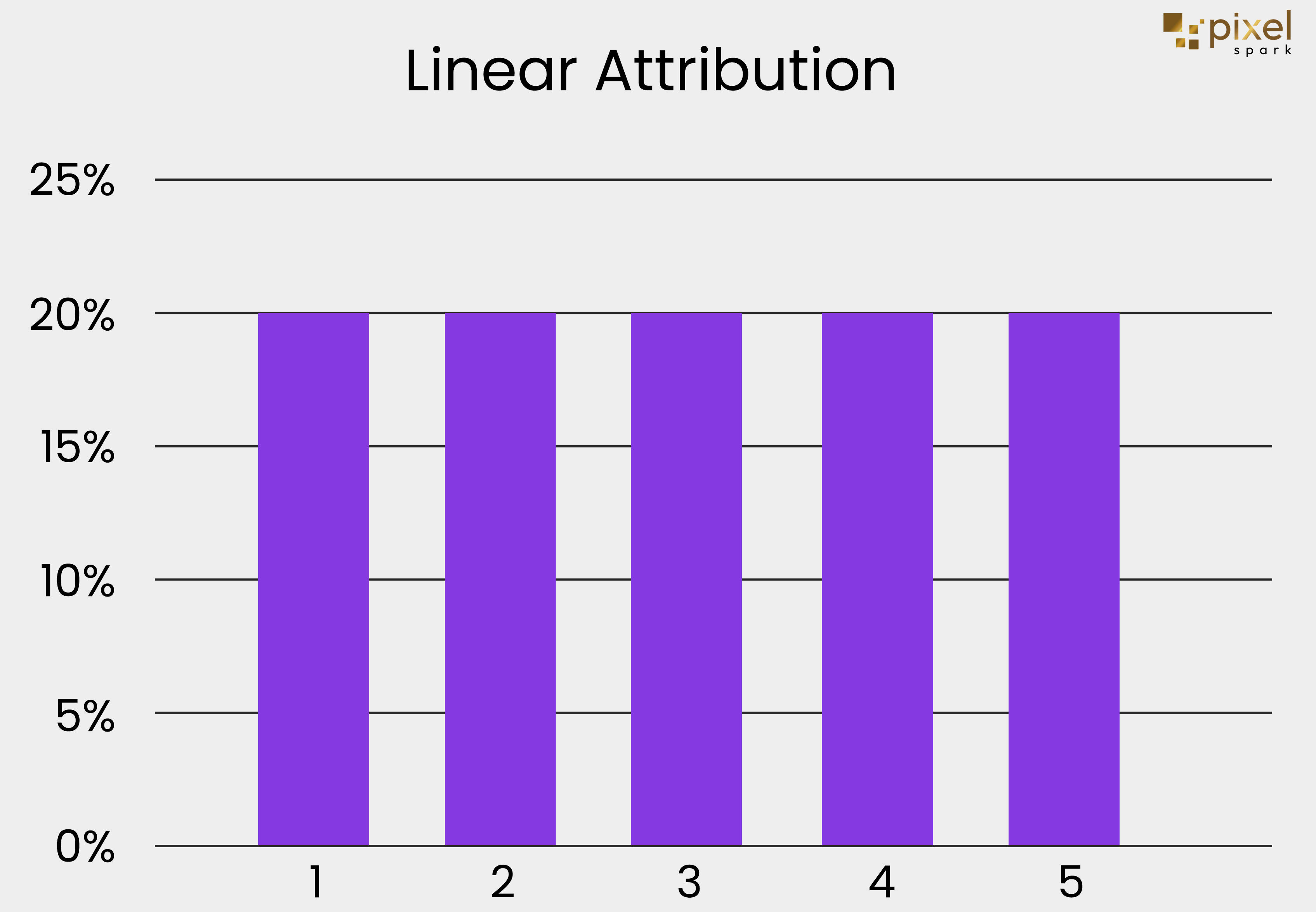
The linear attribution model is a type of multi-touch model that splits the credit for a conversion evenly across every interaction (touchpoint) a customer had before making a purchase.
How the Credit is Split
- If there are five touch points in the customer journey, each one gets 20% of the conversion credit.
- If there are ten touch points, each one gets 10%, and so on.
The Good Newsand The Catch
- This model allows marketers to see the customer journey as a whole and helps optimise the entire picture, not just one specific interaction.
- It is a good starting point for teams looking for a balanced view of what’s working across their marketing funnel, without needing complex analytics tools.
- It can also be used as a baseline model for comparison when you start testing more advanced multi-touch strategies.
- Because the credit is split evenly, it doesn’t account for the fact that some touch points are more important than others. This means high-performing interactions might get less credit than they deserve, while low-performing interactions might get too much.
5. Time-Decay Attribution
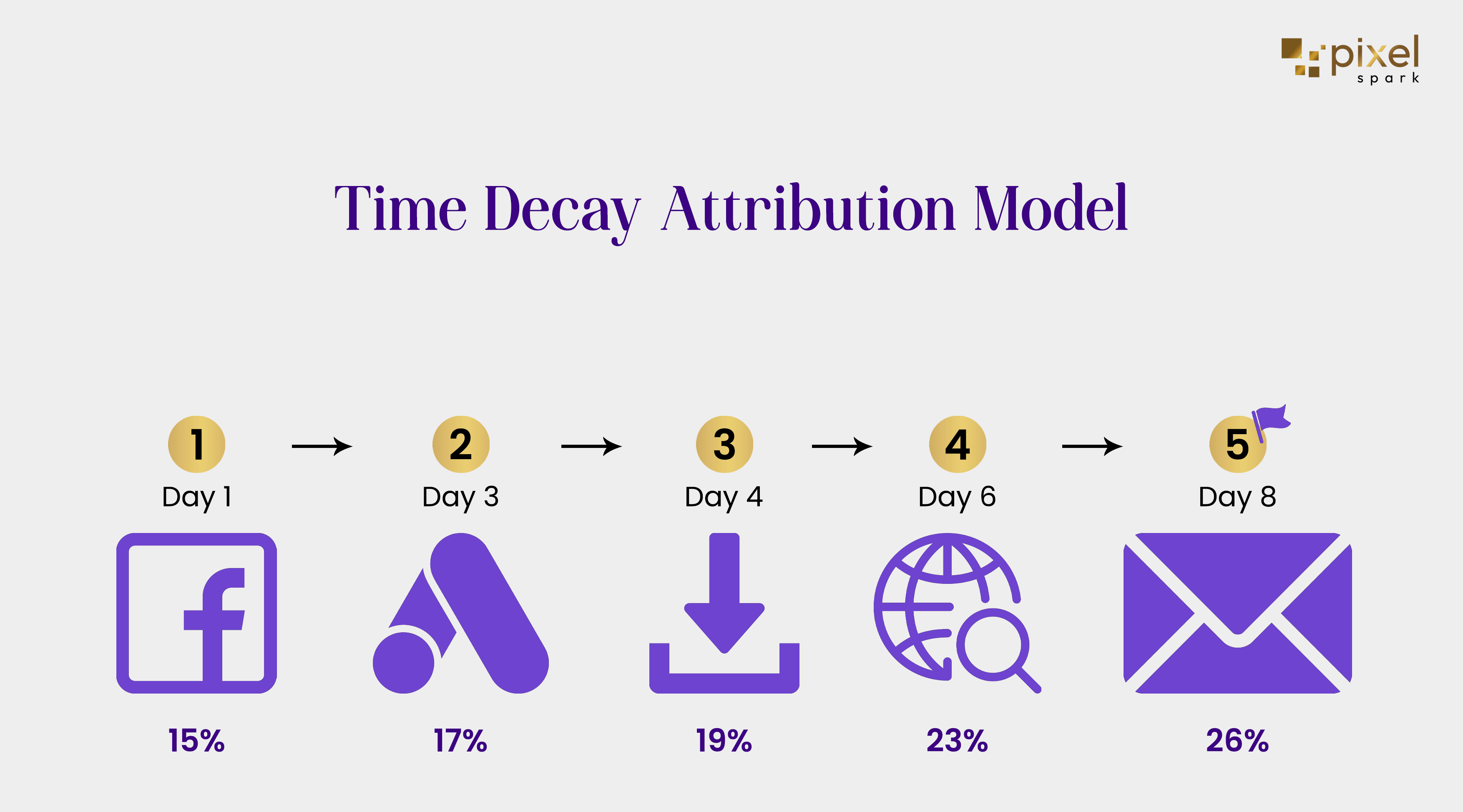
The time-decay attribution model assigns more credit to the touch points that happen closer to the customer’s final conversion.
Focus: Timing and Momentum
- In this model, the last few interactions, like clicking an email or a retargeting ad, are given more weight than earlier touch points.
- This approach reflects how customer behaviour changes: a person might browse casually at first, but act with more serious intent right before they buy.
- It is a logical model for longer customer journeys where timing and building momentum are key to completing the sale.
The Good News and The Catch
- If you run long-term nurturing campaigns or have an extended sales cycle, time-decay offers good insights.
- It helps you see what specific interactions are accelerating a purchase decision.
- The main drawback is that it can undervalue the early-stage marketing efforts that originally sparked the customer’s interest.
- Awareness-building efforts, such as initial content or top-of-the-funnel ads, may appear less effective than they truly were because they occurred so early in the journey.
- While it reveals what speeds up the decision, it doesn’t give you the full picture of every factor involved.
6. U-Shaped (Position-Based) Attribution
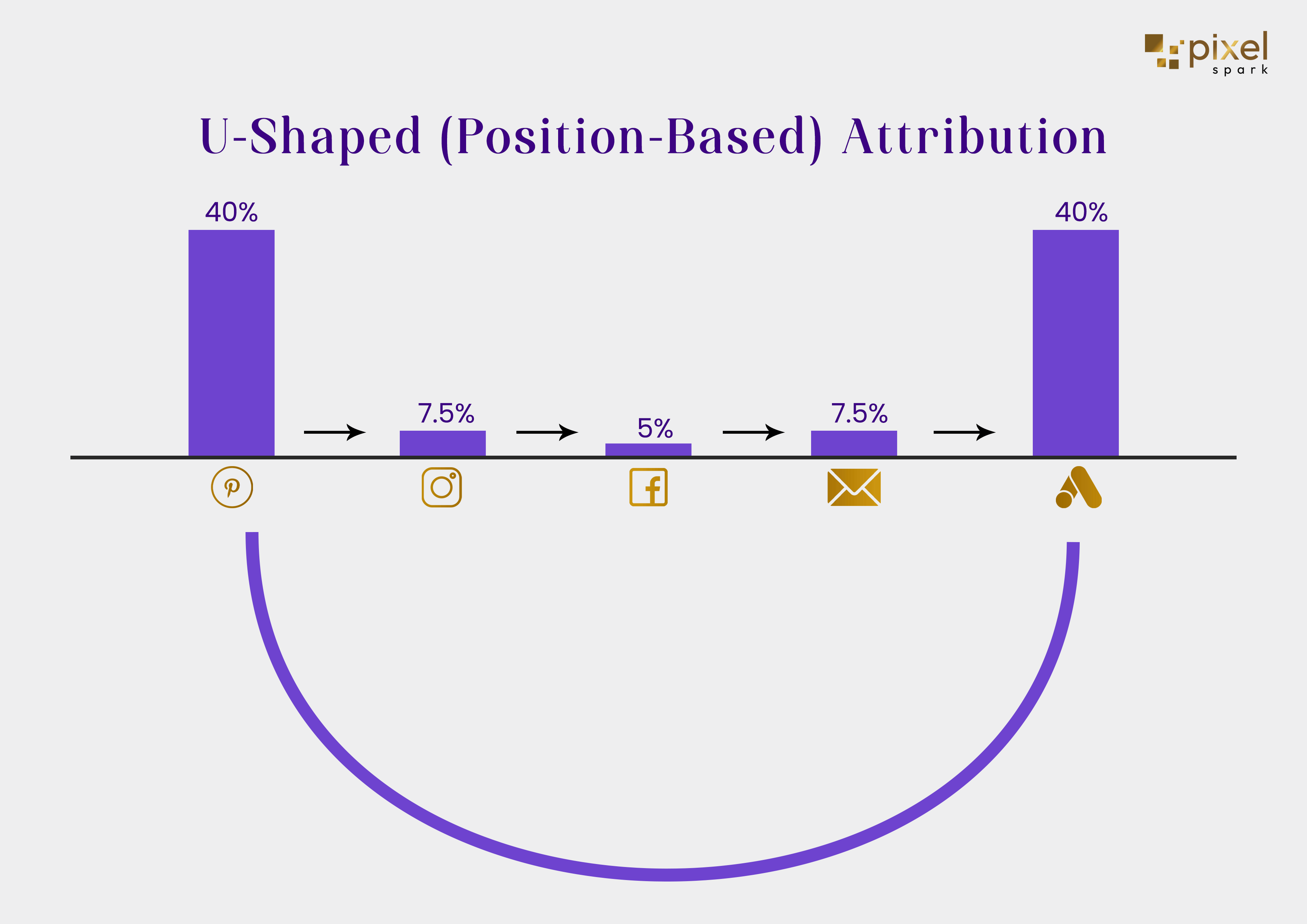
The U-shaped attribution model, also known as the position-based attribution model, balances the focus between the start and the end of the customer journey.
How the Credit is Split
- It assigns a significant portion of the credit to the two most critical points:
o First Touch Point: Gets 40% of the credit.
o Last Touch Point: Gets 40% of the credit.
- The remaining 20% is split evenly among all the touch points that occurred in between the first and last interaction.
The Good News and The Catch
- This model is a popular middle ground because it recognises the importance of both the entry point (how the customer found you) and the final push (what drove the conversion).
For example, if a customer finds you through a blog post, engages later via email, and then buys after clicking a retargeting ad: The blog post (first touch) and the retargeting ad (last touch) would receive the highest share of the credit.
- For many marketing teams, the U-shaped model offers a good balance of simplicity and detail.
- The main issue is that the first and last touch points receive a large, fixed percentage (40% each).
- This large fixed share can sometimes lead to over-reporting on both ends of the customer journey, possibly giving them more credit than they truly deserve compared to the middle steps.
7. Custom or Algorithmic Attribution
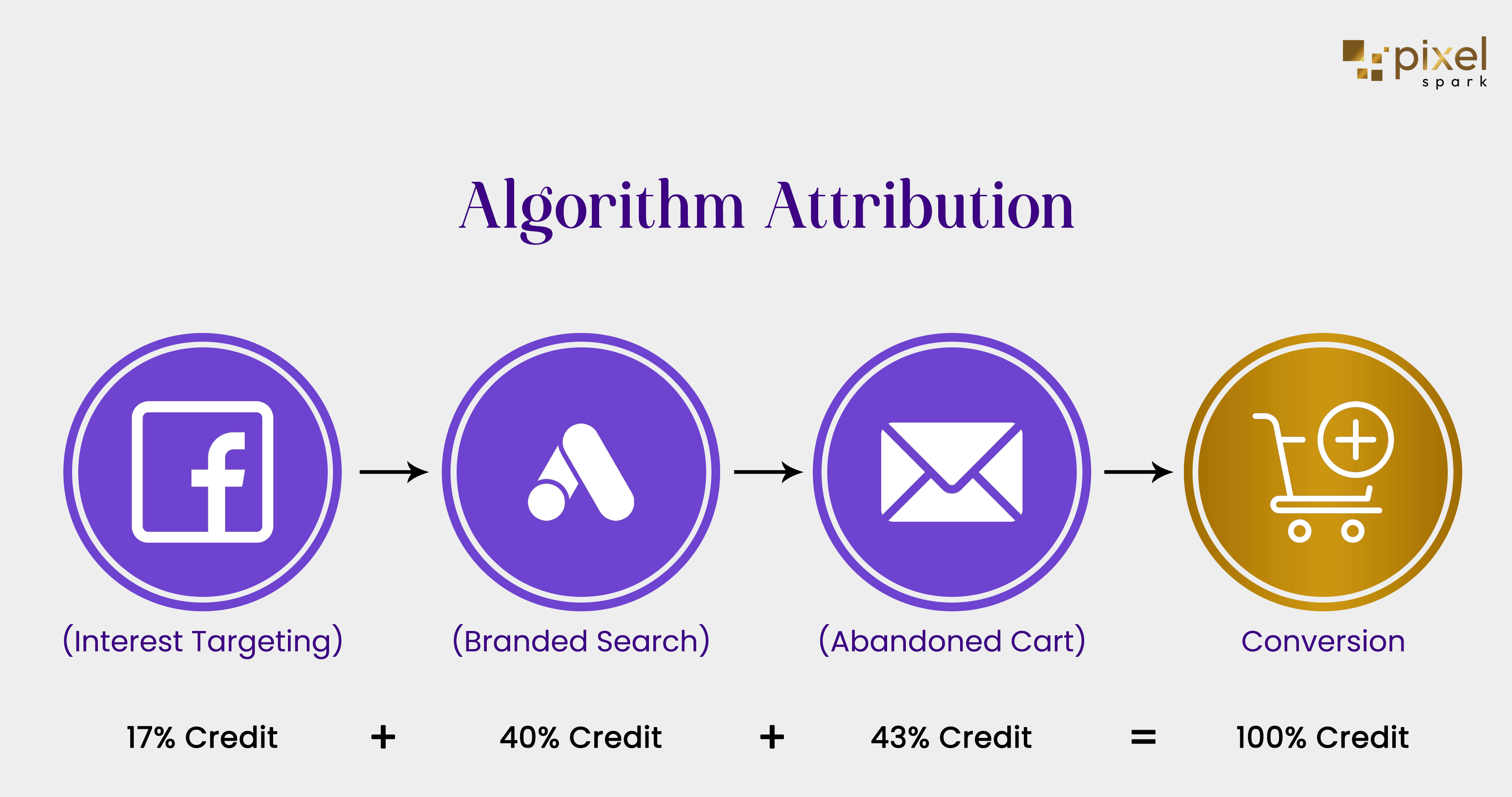
The Custom, or Algorithmic, attribution model is the most technical and precise approach to measuring marketing performance.
How It Works
- This model is built by a data scientist to perfectly match the specific customer journey of a particular business.
- It analyses your actual conversion paths and uses complex mathematics to determine the true impact (or weight) of each touch point.
- The result is an attribution solution that is unique to your business, your audience, and their buying behaviour.
The Good News and The Catch
- Algorithmic attribution is, by far, the most accurate model available. However, it is also the most complex to build.
- Generally, you need a dedicated data science team or an advanced analytics platform to create and manage it. This makes it challenging for smaller organisations or teams with limited resources.
- Fortunately, some advanced marketing platforms now offer basic algorithmic models “out of the box”. This provides smarter attribution without needing to build the entire system from scratch.
- If your marketing efforts are already large-scale and heavily data-driven, this model can uncover deep insights that simple, rules-based reporting cannot provide.
8. Rules-Based Attribution
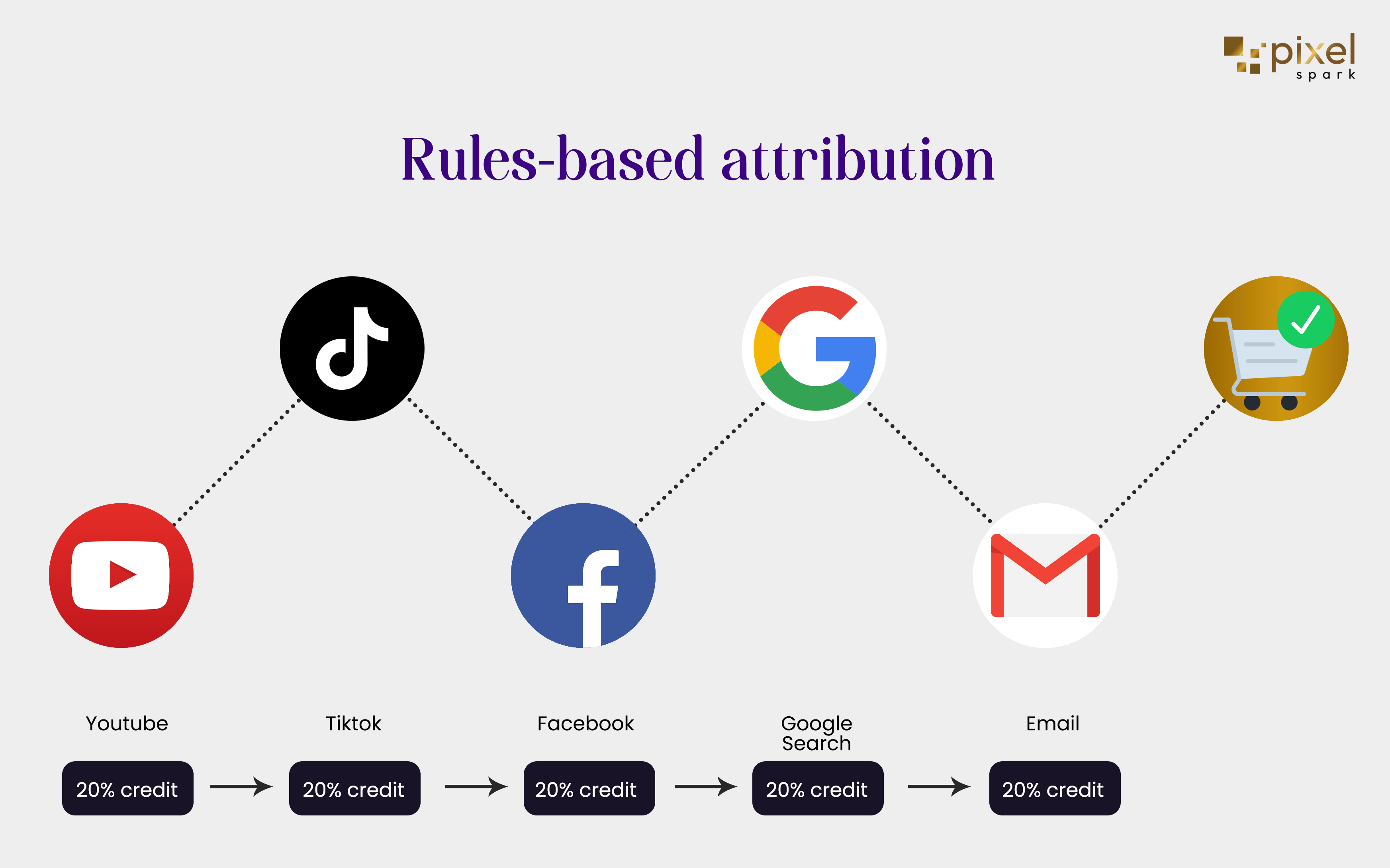
Rules-based attribution allows you to decide exactly how credit is assigned across the customer journey using your own logic, rather than a fixed, pre-set formula.
How It Works
- This model lets you define the weights for different touch points.
Example: You could set a rule to assign:
20% of the credit to the first touch.
20% of the credit to the last touch.
The remaining 60% is distributed based on criteria like customer engagement level or the specific funnel stage.
- This approach gives you more control and customisation without needing complex AI or machine learning technology.
- Rules-based attribution works best for marketing teams that need more flexibility than simple single-touch or rigid multi-touch models (like Linear or U-Shaped).
- It’s the perfect choice for teams that do not have the resources to build a full, complex algorithmic model.
The Good News and The Catch
- It’s especially useful when you have a clear understanding of your company’s sales cycle and how your customers buy.
- It allows you to align your attribution reporting directly with your internal Key Performance Indicators (KPIs).
- The main disadvantage is that this model is still built on human assumptions and decisions.
- If your chosen weighting or logic is inaccurate, the resulting data may mislead your team and cause you to make poor optimisation choices.
9. W-Shaped Attribution
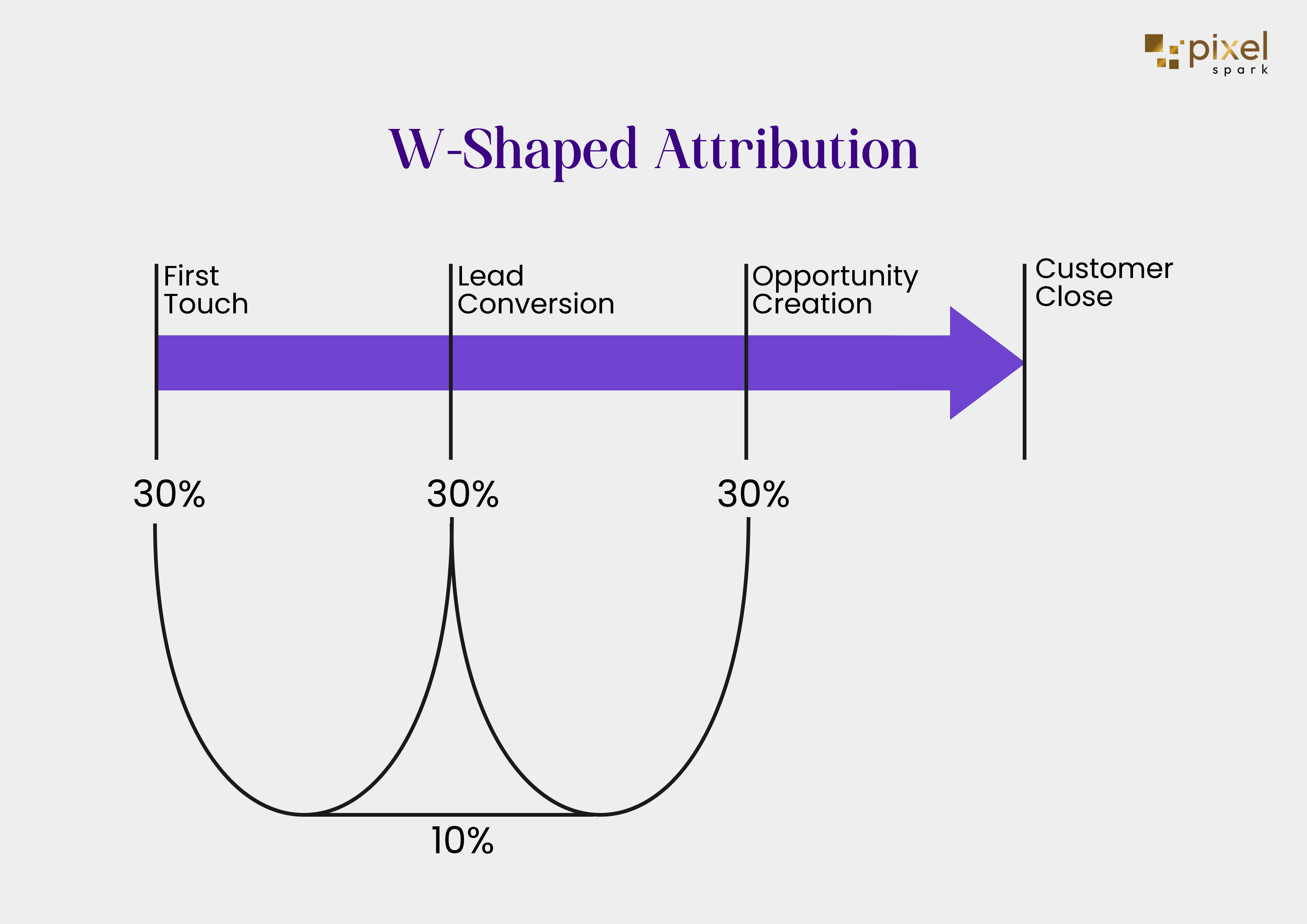
The W-shaped attribution model is a multi-touch approach that focuses credit on three critical milestones in the customer journey.
How It Works
This model assigns a large percentage of credit to the moments that signal serious interest:
- First Interaction: Gets 30% of the credit (the initial discovery).
- Lead Conversion: Gets 30% of the credit (the point where the visitor becomes a known lead).
- Opportunity Creation: Gets 30% of the credit (the moment the lead signals intent to buy or enters the sales pipeline).
- The remaining 10% is then distributed evenly across all the other touch points in between.
The Good News and The Catch
- This model is especially useful for B2B marketers who manage leads through a long, defined sales funnel.
- It highlights these “hand-raising” moments (the three W-points) while still giving some credit to the rest of the customer journey.
For example, all three of these actions receive the highest share of credit if a user:
- Finds a blog via search (First Touch).
- Downloads a cheat sheet from the blog (Lead Conversion).
- Attends a webinar (Opportunity Creation).
- However, the main drawback is that it assumes every customer journey fits this three-milestone mould.
- It may not work well for shorter, less structured funnels where customers don’t always go through these clear-cut steps.
- For managing long, complex buyer journeys, the W-shaped model gives you more detail than the U-shaped model without the complexity of algorithmic attribution.
10. Data-Driven Attribution
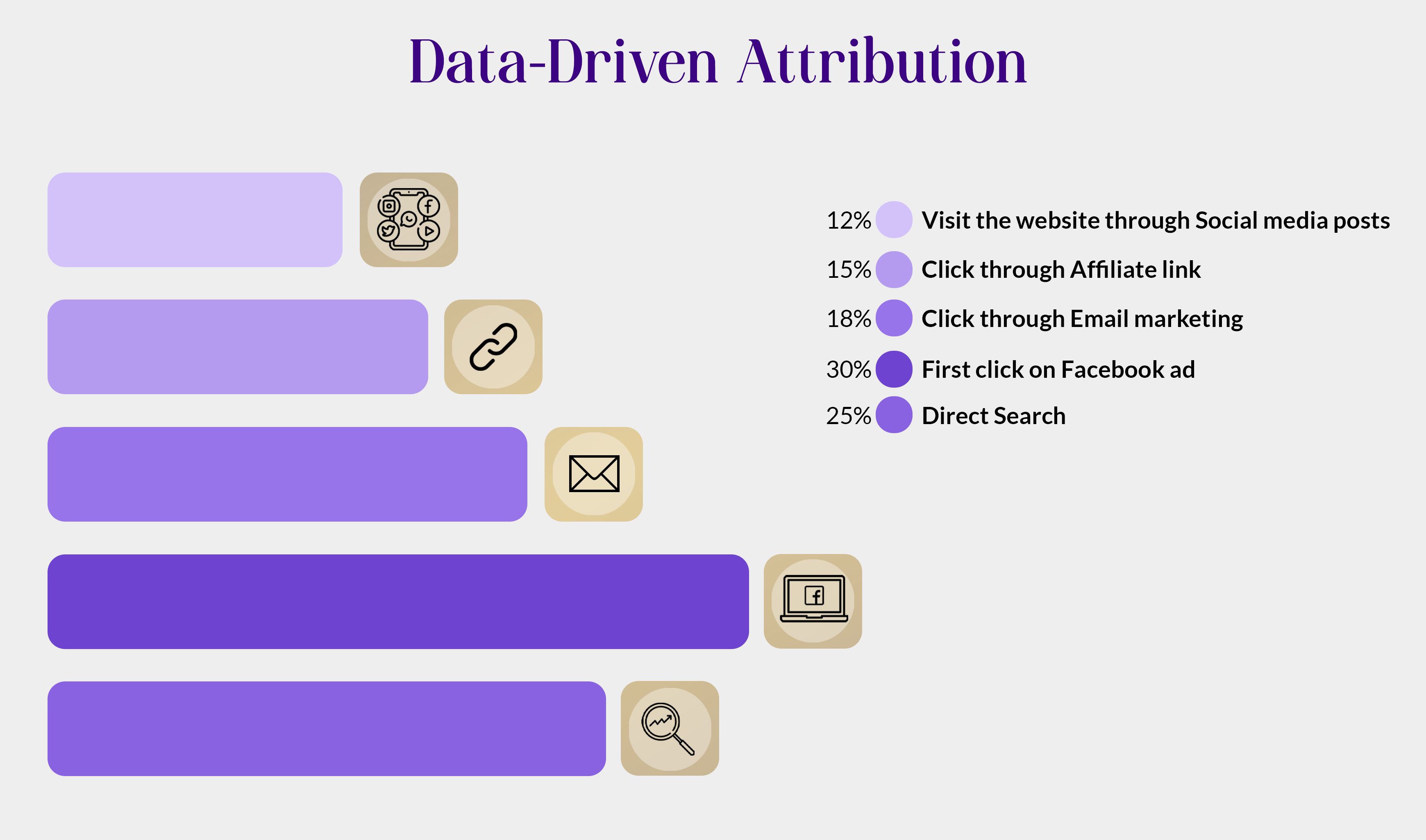
Data-Driven Attribution (DDA) uses machine learning (a type of AI) to assign credit for conversions. It does not rely on fixed, predefined rules or human assumptions.
How It Works
- DDA is an intelligent model that analyses all your actual conversion paths.
- It determines how different touch points truly contribute to a sale or conversion and distributes credit accordingly.
- Unlike simpler models (like Linear or Position-Based), DDA adapts over time based on real customer behaviour, giving you a dynamic view of performance.
The Good News and The Catch
- It offers a more objective view of what is influencing performance because it removes the bias of manual (human) weighting.
- Platforms such as Google Analytics and certain CRMs now offer DDA as a built-in model, making it more accessible than building a fully custom, algorithmic system from scratch.
- The accuracy of DDA is directly tied to the quality of your underlying data.
- Flawed insights will occur if you have issues like inaccurate tracking, broken events, or missing conversion data. Your attribution is only as good as the information you feed the system.
Guide to Choosing the Right Attribution Model for Your Business
Selecting the best model isn’t about finding a perfect one. It’s about finding the right fit for your specific situation. Here are key considerations:
- Map your customer journey: Understand how people discover you, engage, convert. If your journey is short and simple, single-touch might suffice. If it’s multi-channel and spans time, multi-touch or algorithmic makes more sense.
- Define your business goals: Are you optimising for lead generation, immediate sales, high-value customers, or lifetime value? The model should align with what matters most.
- Audit your data and tracking: If you don’t have reliable end-to-end tracking, don’t jump into a complex model. Begin simpler, build better measurements first.
- Test & adjust: Your model today might not suit tomorrow. As your marketing matures, revisit your attribution model. Use tools (for example, GA4’s model comparison) to see how results shift under different models.
- Prioritise actionable insight over perfect model: The goal is to improve decisions (where to invest, what to cut). A “good enough” model that you act on is better than a perfect model you never use.
Key Challenges in Digital Marketing Attribution
Even with a solid model, real-world constraints often hamper attribution. Some common problems can be:
- Unfinished or imprecise tracking: If conversions are not properly tracked, or you’re missing touchpoints (cross-device, offline channels), your attribution can be skewed.
- Cross-device and cross-channel journeys: A user can research on mobile, change to desktop, click an ad, and return through email. If your analytics don’t put those together, you’ll mis-assign credit.
- Siloed platforms and data: Ad platforms, CRM, and web analytics may not always share data. That fragmentation makes it hard to see the full customer path.
- Resource limitations: Advanced models (algorithmic) require analyst time, tech stack, and data engineering. Smaller teams may struggle.
- Misaligned organisational KPIs: If marketing, sales, and leadership define success differently, attribution insights may be ignored or misused.
Attribution Insights You Can Get from Google Analytics
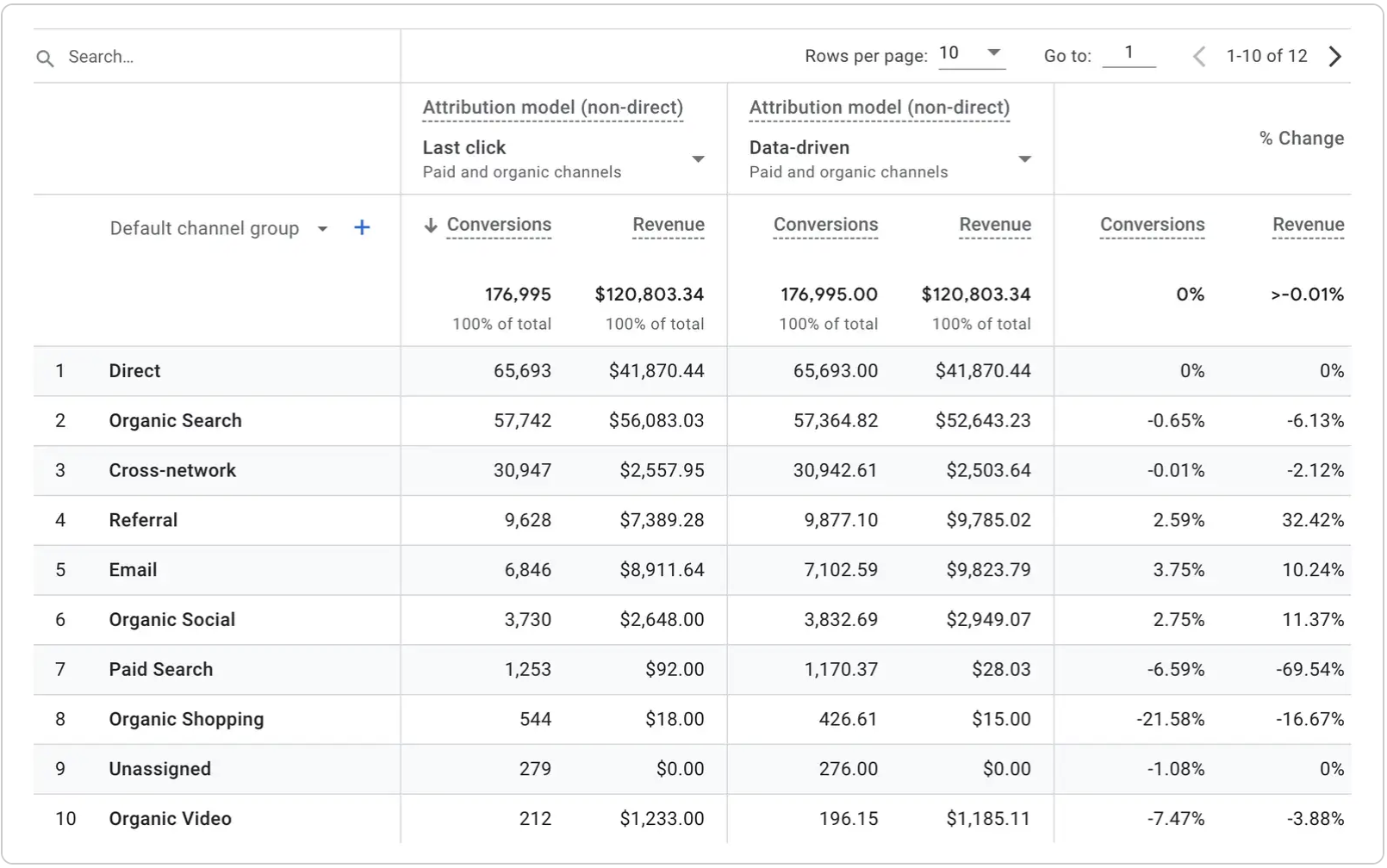
The good news is that modern analytics platforms, especially GA4, give you tools to compare different attribution models side by side.
Key steps:
- In Google Analytics 4, navigate to Reports → Advertising → Model Comparison.
- Pick multiple attribution models (for example, last-click vs linear vs data-driven) and compare how credit shifts across channels.
- Look for major shifts: for example, maybe your email channel shows up strong under linear, but weak under last-click. That’s a signal.
- Use the insights to revisit your channel budget, campaign mix, and perhaps your attribution model itself.
- Remember: none of the tools fix bad data. Before you trust what you see, ensure your tracking, channel tagging and conversion setup are solid.
FAQ
Is marketing attribution different from marketing analytics?
+
Marketing attribution primarily focuses on the touchpoints that lead to conversions, while marketing analytics gives an overview of the overall performance. With attribution, businesses can give a better insight into what drives results.
Is marketing attribution important for small businesses?
+
Yes. Attribution helps in identifying the channels that bring effective results, even with a limited budget. This means mitigation of wasteful spending and a better ROI.
Can marketing attribution work across both online and offline channels?
+
Yes. Proper tracking methods like UTM parameters, call tracking, CRM integration, or offline conversion import can give a complete view of the customer journey.
What tools do I need to get started with marketing attribution?
+
Some tools that help you set up reliable tracking and attribution without needing advanced setups are: GA4, Google Tag Manager, ad platform analytics (Meta, Google Ads, LinkedIn) and CRM systems.
Conclusion
Attribution need not be perfect for your business right from day one. The key is to pick a model that suits your business. Then you can start measuring, get insights, and take action. When you measure better, you spend smarter. As your marketing campaigns become more complex, your attribution approach should evolve accordingly.
Good attribution is not about complexity. It is more about clarity. It shows-
- Which channels create real impact
- Helps you spot wasted spend
- Guides you towards smarter investment decisions
With reliable tracking and a model that matches your goals, you can optimise your marketing with confidence and focus on what actually drives growth.
At Pixel Spark, we understand the rhythm of social storytelling and what truly moves an online audience. If you want content that feels effortless, intentional, and built to convert, we are here to make it happen!
Let us create for you what actually moves people!