-
By Gunjan Gupta
- In Uncategorized
PMax & AI Max Explained for 2026: How to Win When Google Is Driving (and You are in the Passenger Seat)
Hey. If you are reading this, you are probably seeing the same scary pattern: High spending, lots of “AI-optimised” labels, but unpredictable results.
Google Ads has changed. The old way (pick keywords, set bids) is dead. The new way is about managing Google’s AI. You are no longer the driver. You are the flight engineer.
This guide gives you the exact, simple, actionable steps to stop wasting budget and start winning with Performance Max (PMax) and AI Max.
The New Rules & Basics (PMax vs. AI Max)
The first step to winning is knowing what tools you have. You have two main AI tools. They are NOT the same.
| Feature | PMax (The Whole Car) | AI Max (The Turbo Button) |
| What is it? | A full, separate, all-in-one campaign for maximum SCALE. | A feature to boost your existing Search campaigns for maximum PRECISION. |
| Where Ads Go? | Everywhere: Search, YouTube, Display, Gmail, Maps. | Only on Search: Where people actively type queries. |
| Your Goal | Find the most customers possible, fast. | Get the most value on Search, efficiently. |
| Your Control | LOW (“Black Box”): Minimal visibility into channels/placements. | HIGH: You keep control over negative keywords and search terms. |
The New Reality: Google Ads is Negotiated
Forget the old playbook. In 2026, you must switch your focus to four things:
- Defining Goals: What dollar value does a conversion have?
- Supplying Signals: Giving the AI high-quality hints about your customers.
- Setting Boundaries: Telling the AI where NOT to spend your money.
- Auditing Outcomes: Checking if the AI’s results actually make you profit.
You design the conditions. The AI executes the plan.
Mastering PMax (The Delegation Strategy)
PMax is Google saying: “Tell me what you want, I’ll figure out the best path.”
It handles everything: Channels, bidding, budgets, and creative combinations. This is delegation, not optimisation.
What Is Performance Max (PMax)?
Performance Max (PMax) is a highly automated, goal-based campaign type in Google Ads.
It is one single campaign that gives you access to all of Google’s ad channels at once. The goal is to drive the maximum number of conversions (or conversion value) based on the specific goal you set. The driver is Google AI (Machine Learning).
PMax: What It Controls for You
PMax is designed for scale and hands all the execution tasks to the AI. This is where most control is lost, but where reach is gained:
-
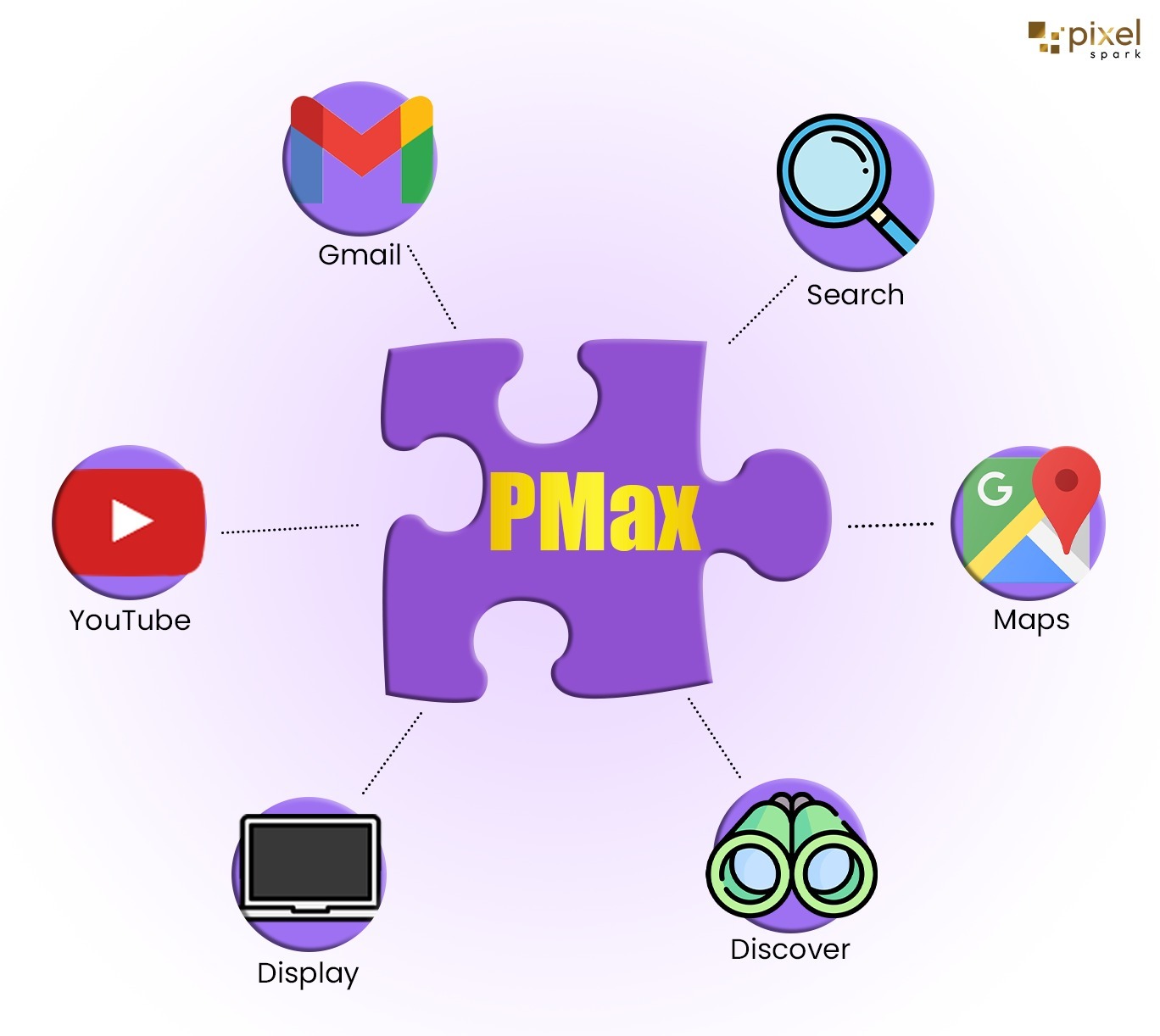
Cross-Channel Access: Your ads will show up across Search, YouTube, Display, Gmail, Maps, and Discover.
- Bidding: The AI uses Smart Bidding to calculate the perfect bid for every single user, in every single auction, in real-time.
- Budget Flow: The system automatically moves your daily budget between Search, YouTube, Display, etc., putting money where it thinks conversions are most likely.
- Ad Creation: It takes the assets you upload (headlines, images, videos) and dynamically mixes and matches them to create the best ad for that specific spot and user.
PMax: What You Control (Your Only Job)
Since you do not control the day-to-day bidding or placement, your job becomes the Input Manager.You only control the ingredients:
- The Goal: Defining the dollar value of a conversion.
- The Assets: Providing high-quality creative (text, images, video).
- The Signals: Giving the AI hints about who your best customers are (e.g., your customer lists).
Bottom Line: PMax is the Delegation Campaign. You delegate the “how” (where to run, what to bid) and focus 100% on the “what” (your goal and creative quality).
Crucial Step: Building the First-Party Customer List Signal
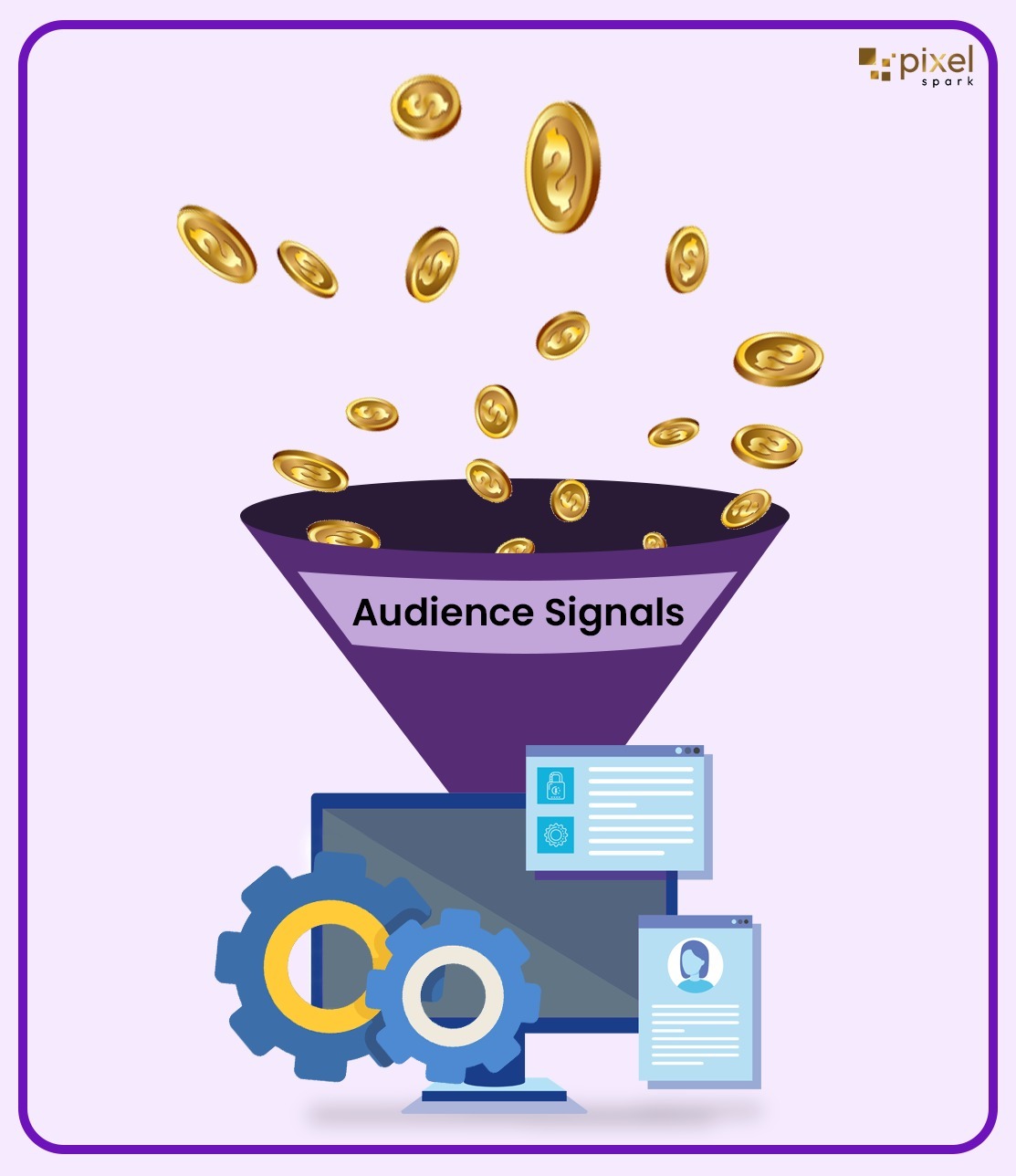
The fastest way to train PMax is not with keywords, but with high-quality data about your existing best customers. This is called Customer Match, and it’s the ultimate Audience Signal.
The Power: You upload a list of customer details (emails, phone numbers,
addresses). Google matches these to signed-in users. PMax then uses this list to find “lookalike” customers across all channels who behave similarly to your most profitable buyers.
How to Build the List (The Data Hygiene Checklist)
| Data to Upload | Why It’s The Best Signal | Actionable Best Practice |
| High-Value Buyers | Trains the AI on what a profitable conversion looks like (crucial for Max Conversion Value). | Export your list of customers who have purchased 2+ times or who have the highest Lifetime Value (LTV). |
| Recent Leads/Sign-Ups | Trains the AI on the start of a high-value customer journey. | Export newsletter sign-ups or demo requests from the last 90 days and refresh the list weekly. |
| Format: Customer Match | Ensures a high “match rate” (how many customers Google finds). | Use a CSV file. Include multiple match keys (Email, Phone, First Name, Last Name). More fields = higher match rate. |
PMax Step 1: Control Your Inputs
PMax lives and dies by the inputs you give it.
| Input You Must Control | Why It Fails When It’s Wrong | Action You Must Take NOW |
| Conversion Goal (The Brain) | The AI chases the easiest conversion (e.g., a newsletter sign-up) instead of the high-value conversion. High volume, zero profit. | ACTION: Switch from “Maximise Conversions” to “Maximise Conversion Value.” Assign a high dollar value to actions that make you money. BONUS: Use a Conversions API to pass the exact transaction price. |
| Assets (The Ads) | Weak, generic images or no video. The AI amplifies bad creative across YouTube and Display, wasting huge spend. | ACTION: Upload all possible asset sizes. Never let Google auto-generate a video. Provide at least one 15-second brand-safe video. |
| Audience Signals (The Hint) | You don’t give the AI a high-quality starting point. The AI wastes time and money exploring cold, irrelevant audiences. | ACTION: Upload your First-Party Customer Lists (Customer Match). This is the best signal PMax can get. |
Recent Experience: The $50k Value Flip.
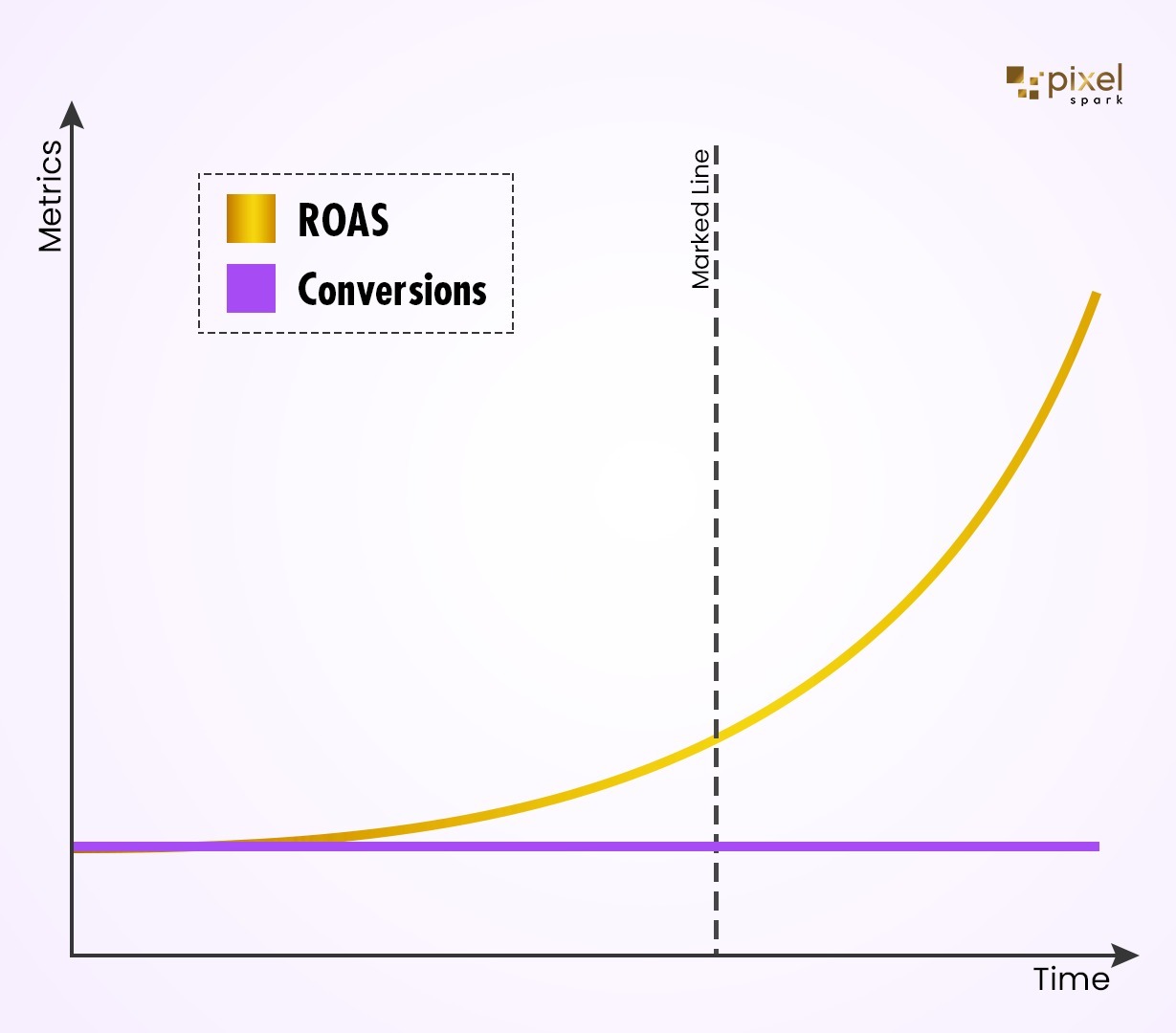
We had an e-commerce client where PMax was generating 1,000 conversions but losing money. The AI was optimising for any product sale. We changed the goal to Maximise Conversion Value and used the Conversions API to pass the actual product price.
The conversion count dropped by 30%, but ROAS shot up by 2X because the AI immediately began prioritising sales of $500 items over $20 items, guided by the precise value and our Customer Match list.
PMax Step 2: Stop Fiddling. Let It Learn.
PMax needs 2 to 4 weeks to complete its Learning Phase.
- The Mistake: You pause, change assets, or adjust the budget within the first 14 days.
- The Result: You reset the learning. You force the AI to start over, burning more budget.
- The Rule: Patience is Profit. Once you set the goal and assets correctly, do not interfere. Let the machine learn.
PMax Step 3: Face the Black Box Risks
PMax has serious drawbacks you must manage:
- Black Box Problem: You don’t see exact placements or budget splits.
- Fix: You can only guide the outputs with better inputs (Step 1).
- Cannibalisation: PMax can overlap with and steal traffic from your high-performing Brand or Shopping campaigns.
- Fix: Keep your core campaigns running. Use exclusions where possible and closely monitor reporting to detect overlap.
- Bad Tracking: PMax finds the fastest path to your goal. If your goal is duplicated or wrong, PMax finds more bad results.
- Fix: Automation exposes flaws. Ensure your conversion tracking is 100% accurate before launching.
Turbo-Charging with AI Max (The Precision Strategy)
AI Max is NOT a replacement for PMax. It’s a tool for intelligent search refinement.
AI Max: What It Does Better (And What It Risks)
| Benefit (What AI Max Excels At) | Risk (Where You Need Guardrails) |
| Intent Over Keywords: It understands the meaning of searches, catching long-tail queries you missed. | Over-Expansion Risk: It can aggressively match your ads to irrelevant terms, especially competitor brand names. |
| Transparency: You get clearer search term reports and control over negative keywords. | Creative Dilution: It dynamically mixes your ad copy, potentially watering down your brand messaging. |
| Search Efficiency: It uses AI to automate creative optimisation only within the highly valuable Search Network. | It Still Needs Value: If your goal is poor, AI Max will find poor leads, just more efficiently on Search. |
Recent Experience: The Negative Keyword Rescue
A client turned on AI Max for a standard Search campaign. Within days, their Search Term Report showed spend on competitor brand names and highly irrelevant terms like “free samples”, which were not in their original keywords. We immediately applied a negative keyword list containing [Competitor Name] and [Free] to stop the leakage. This shows the necessity of human oversight in the AI-driven system.
The Non-Negotiable Guardrail Strategy
To use AI Max without budget leakage, you must set boundaries from day one:
- Block Competitors: Set strong negative keyword lists before launch to block competitor brand names.
- Exclude Search Partners: AI Max often overspends on the low-quality Search Partner Network. Exclude this network unless you have clear data proving its value.
- Active Review: Because of the over-expansion risk, you must check your search term reports weekly for new irrelevant phrases to add to your negative list.
The Smart Strategy: Use Both, Win Big
The best accounts don’t choose one. They separate the work.
Separate Discovery from Intent
| Campaign | Primary Role | Funnel Stage | Goal Focus |
| PMax | Discovery & Scale (Find New Audiences) | Upper & Mid-Funnel | Maximise Conversions (for new leads) or Max Value (New Customer Acquisition mode). |
| AI Max | Precision & Efficiency (Capture Ready-to-Buy) | Bottom-Funnel | Max Conversion Value (for branded or high-intent searches). |
Example: You sell shoes.
PMax finds people browsing YouTube for “best running shoes” (Discovery).
AI Max catches people searching on Google for “YourBrandName black shoe size 10” (High Intent). This system prevents the PMax “Black Box” from messing up your most valuable, ready-to-convert traffic.
Your Final Takeaway: You Are the AI Supervisor
You are not being replaced. You are being promoted.
Your value is no longer in:
- Mindlessly changing bids.
- Hoarding keywords.
Your value is now in:
- Goal Design: Fixing the dollar values of every single conversion.
- Data Hygiene: Ensuring flawless tracking.
- Guardrail Thinking: Setting the strict boundaries and exclusions for the AI.
AI accelerates good strategy, but it also accelerates bad data. Control your inputs. Set your boundaries. Own the outcome.
PIXEL SPARK POV: The AI Supervisor Mentality
Your Value Has Changed, Not Ended.
These systems don’t fail because they lack intelligence. They fail when businesses mistake automation for strategy.
The era of mindlessly tweaking bids is over. Your power as a marketer has simply shifted upstream. You are no longer paid to execute tasks; you are paid to manage the machine’s inputs.
Automation is not a replacement for thinking. It is an amplifier.
- Used Correctly: PMax and AI Max don’t reduce control; they shift it to the high-leverage points: Goal Design and Guardrails.
- Used Incorrectly: They take your bad tracking and vague goals, and scale those failures to every channel, faster than you can pause the campaign.
Action Check: Where is Your Biggest Leak?
If your PMax or AI Max campaigns are underperforming, the problem is almost always found in one of these three foundation layers:
- Goal Design: Are you tracking Conversions (quantity) instead of Conversion Value (profit)?
- Data Hygiene: Is your website tracking flawless? Are you feeding the AI high-quality Audience Signals (customer lists)?
- Creative Quality: Did you upload a poor video and expect the AI to turn it into YouTube gold? Weak assets = amplified failure.
If you want a second set of eyes on how automation is truly shaping your account, we are always open to thoughtful conversations before problems compound. Don’t surrender your results; govern the AI.
FAQ: Performance Max (PMax) vs. AI Max for Search
1. What is the core difference between Performance Max (PMax) and AI Max for Search?
Performance Max (PMax) is a full, goal-based campaign type designed to scale results across all Google inventory, including Search, YouTube, Display, Discover, and Gmail.
AI Max, in contrast, is an AI-powered optimisation layer applied only to Search campaigns, offering improved intent matching and creative optimisation while retaining more control.
2. Why is tracking Conversion Value, not just Conversions, essential in PMax?
PMax optimises exactly what it is rewarded for. If you track only conversion volume, the system may prioritise low-quality or low-value leads. Tracking conversion value allows PMax to optimise for profitability and ROAS, aligning AI optimisation with real business outcomes.
3. What is the “Black Box” problem in Performance Max, and how can it be managed?
Performance Max is often described as a “Black Box” because it provides limited visibility into channel-level spend, placements, and search terms. This cannot be solved through controls but only through better inputs. High-quality conversion data, accurate values, and strong creative assets are the primary levers that guide the AI’s opaque decision-making.
4. How long should a new PMax campaign run before making changes?
A new Performance Max campaign should be allowed to complete its Learning Phase, typically lasting 2 to 4 weeks. Making structural changes before this phase ends resets learning and destabilises performance, often leading to inconsistent results.
5. What is the biggest risk of enabling AI Max in Search campaigns?
The primary risk with AI Max is over-expansion. The system may aggressively match to loosely relevant or competitor-related queries, increasing impressions without proportional returns. Ongoing negative keyword management is critical to controlling costs and maintaining relevance.
6. Does Performance Max create a video asset automatically if none is provided?
Yes. If no video asset is uploaded, Google auto-generates one. However, these videos are usually generic and underperform on visual channels. Providing a custom 15–30 second brand-safe video significantly improves performance on YouTube and Display placements.
7. What is the difference between Audience Signals in PMax and Search Themes in AI Max?
Audience Signals in Performance Max suggest who your customer might be, using data such as customer lists and demographics. Search Themes in AI Max focus on what your customer is searching for, helping the system identify relevant intent and long-tail search queries within Search campaigns.
8. Can Performance Max and AI Max campaigns run simultaneously?
Yes, and they should. The most effective strategy uses Performance Max for discovery and scale across the mid-funnel, while AI Max is reserved for precision and efficiency in high-intent Search conversions at the bottom of the funnel.
9. How does a strong SEO website improve Performance Max results?
A well-optimised website sends high-quality relevance signals to Google Ads. Faster load times, clear content structure, and intent-aligned pages improve ad relevance, strengthen Quality Score indicators, and help PMax identify and convert the right users more effectively.
10. Does AI Max offer advantages for targeting local markets like India?
Yes. AI Max leverages advanced AI models to understand local intent, linguistic variation, and regional search behaviour. This makes it particularly effective in markets like India, where queries vary widely across languages and phrasing.