
Ads that convert are built on decisions made before launch, not patched up after the budget is already spent. Every engagement, whether it’s an NGO, a signage business, or a medical equipment manufacturer, goes through the same five steps.

STEP 1: Understanding Your Objective
We start with a discovery conversation to understand your business, not just your marketing brief.
What does a genuine lead look like for you?
What’s the sales cycle?
What’s already been tried, and what failed?
For a lead generation agency, this step matters more than any targeting setting; a campaign optimised for the wrong objective never delivers the right leads, no matter how well it’s run.
STEP 2: Competitor Research
Next, we study what competitors in your category are actually doing: ad creatives, messaging angles, landing pages, offers, and estimated spend levels on both Google and Meta.
This shows us where the market is saturated, where there’s a gap worth owning, and what a realistic cost per lead looks like before we set a budget or a target.
STEP 3: Choosing the Right Platform
Google Ads and Meta Ads work on different psychology. Google captures people already searching with intent, useful for categories like signage and medical equipment, where buyers actively look for suppliers.
Meta reaches and educates an audience that isn’t searching yet, which is why it’s worked well for NGO donor and volunteer campaigns.
We recommend one platform, both, or a phased sequence based on how your buyer actually behaves, never as a default.
STEP 4: Selecting the Right Campaign Objective
Within the chosen platform, the campaign objective decides how the algorithm spends your money- lead form submissions, website conversions, traffic, or awareness.
A manufacturer with a long B2B sales cycle needs a different objective than an NGO running a time-bound awareness push. Getting this one setting wrong is one of the most common and most expensive mistakes agencies make, and it’s invisible on a dashboard until you know to look for it.
STEP 5: Optimising With AI + Human Judgement
Once a campaign is live, most agencies check in monthly. We don’t.
Google’s automated bidding and Meta’s Advantage + audience tools are already doing AI-driven work in the background- our job is to add a second layer on top of that: AI-assisted analysis that reads through weeks of campaign data to flag which ad angle is bringing in real enquiries versus vanity clicks, where budget is quietly leaking, and which audience segment deserves more spend next week.
The AI speeds up how fast we spot the pattern. The decision on what to change is still made by a strategist, not left to a script.
Google Ads Management
Search, display, and performance-based campaigns built around how your customers actually search, including specialised setups for industries like signage and manufacturing, where the buying cycle is longer and the keywords are specific.
As a Google Ads agency for signage companies, we know a click only matters if it turns into a genuine enquiry, not just traffic.

Meta Ads Management
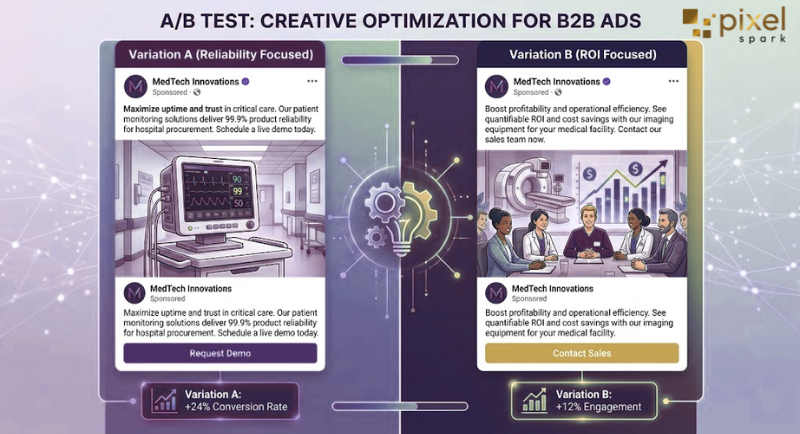
Facebook and Instagram campaigns for lead generation, awareness, and retargeting, built with audience testing, creative testing, and continuous optimisation.
We run Meta ads for medical equipment manufacturers, NGOs, and consumer-facing brands, adjusting the approach to match each industry’s buying behaviour, since a B2B buyer and an NGO donor respond to completely different creative.
Lead Generation Services
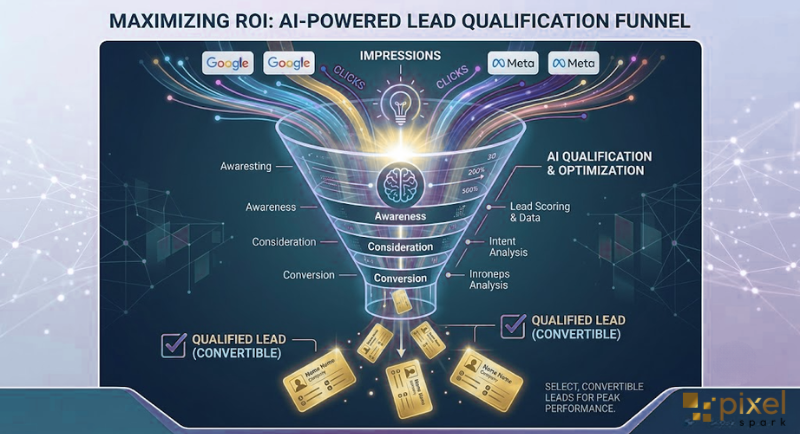
If the goal is simply more qualified leads, not just traffic or impressions, this is where wefocus.
Every campaign is set up with lead quality as the primary metric from day one, not cost per click, and every lead is tracked back to the ad and a udience that produced it.
Let’s Build a Campaign That Actually Converts with Pixel Spark
Whether you’re a signage business, a medical equipment manufacturer, an NGO, or any other business looking for a dependable lead generation agency, we bring together 9+ years of paid media expertise and AI-accelerated analysis to keep your Google Ads and Meta Ads campaigns optimised, analysed, and improving every week.
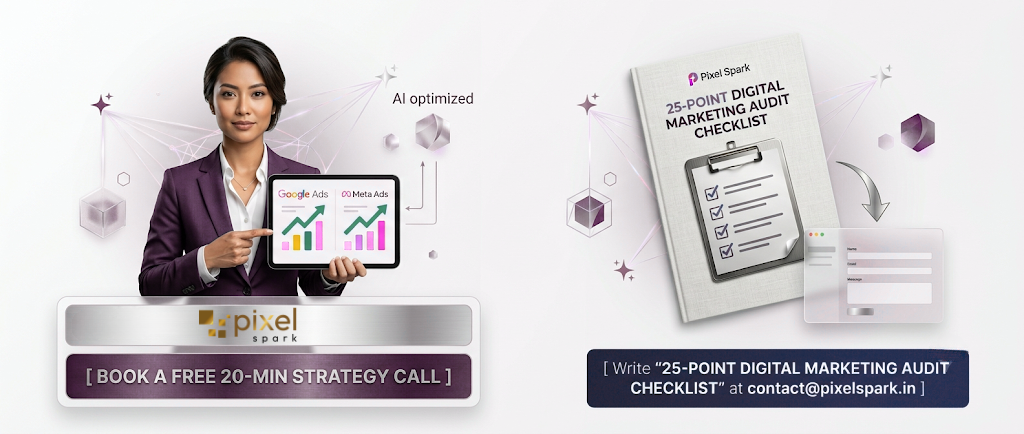
Book a free 20-minute strategy call to discuss a campaign built around your business.
Not ready for a call?
Start with our free 25-Point Digital Marketing Audit Checklist and see where your current marketing stands. Write “25-Point Digital Marketing Audit Checklist” at contact@pixelspark.in

Contact Us
Then book your trip from
our exclusive offers.
Location
Sector- 62 , Noida
Make a Call
+91 9599720144
contact@pixelspark.in