
-
By Gunjan Gupta
- In Uncategorized
Overview
Donors today do not only check a website before giving money to an NGO. Many now ask ChatGPT or Perplexity, “Is this NGO genuine?” or “Which education NGO in India should I support?”
This is a new kind of search, and most Indian NGOs are missing from it. This blog explains AI search visibility for NGOs in India, how donors use ChatGPT for charity research, and how your NGO can get listed in AI answers before your competitors even know this exists.
AI Search Visibility for NGOs in India
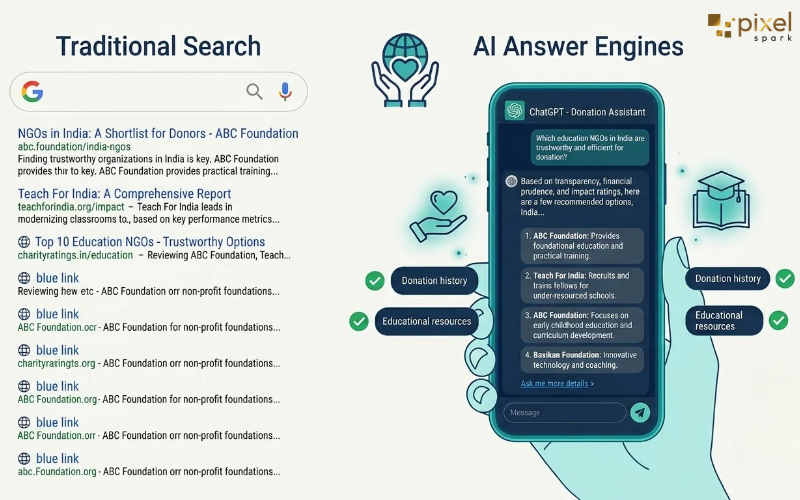
A donor in Bengaluru wants to give money to a child education NGO. Ten years ago, they would Google “best education NGO India” and scroll through links. Today, they may simply ask ChatGPT, “Which education NGOs in India are trustworthy?” The AI gives them two or three names, with a short reason for each.
If your NGO is not one of those names, you lose that donation. You may never even know it was possible.
This is the new reality of giving. And for NGOs, it brings a rare chance. Very few NGOs in India are working on AI search visibility yet. The field is almost empty. That means a small, honest effort today can put your NGO far ahead of bigger names tomorrow.
What Is AI Search Visibility for NGOs in India?
AI search visibility means how easily tools like ChatGPT, Perplexity and Google Gemini can find, understand and recommend your NGO. It is different from simply ranking on Google. It is about becoming the answer, not just a link in a list.
For NGOs, this matters more than for most businesses. Donors do not just want a service. They want to trust a cause with their money. AI tools try to judge this trust by reading your website, your reports, your news mentions and your reviews. If this information is clear and complete, AI tools are more likely to name your NGO when someone asks a related question.
This growing practice is called answer engine optimization for nonprofits. It is the NGO version of SEO, built for an AI-first world.
Why AEO Matters More for NGOs Than for Other Businesses
Answer engine optimization for nonprofits matters because giving is an emotional and careful decision.
A donor researching a charity behaves differently from someone buying a phone case. They want proof of real work, real impact and real honesty, and AI tools try to surface exactly that kind of proof.
When someone buys a product, a wrong choice costs them a little money. When someone donates, a wrong choice can mean their money never reaches the people who need it. Because of this, donors do deeper research. Many now treat ChatGPT and Perplexity like a quick, trusted second opinion, alongside Google.
This means your NGO’s online information needs to answer, in plain words, three questions:
- What problem do you solve, and where?
- How do you use donor money?
- What proof do you have of real impact?
If your website answers these three questions clearly, AI tools find it easier to trust and quote you.
How Do Donors Find NGOs Online in India Today?
Donors in India today find NGOs through a mix of Google search, social media, word of mouth, and increasingly, AI chat tools. This mix is shifting fast. Younger, urban donors especially now start their research with a direct question to ChatGPT or Perplexity instead of typing keywords into Google.
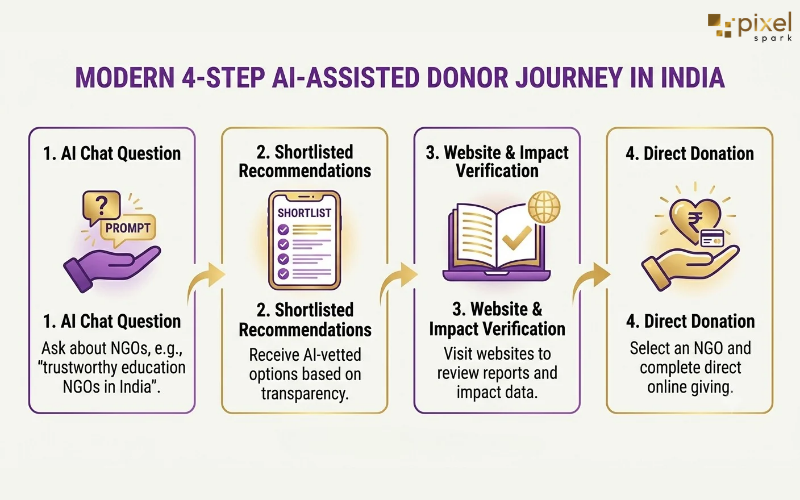
A few years ago, the donor journey was simple: search, click, read, decide. Today, it often looks like this instead:
- The donor asks an AI tool a broad question, like “Good NGOs for girl child education in India.”
- The AI tool gives two or three names, with a one-line reason for each.
- The donor then checks the NGO’s website and social pages to confirm the claim.
- If everything matches, they donate or sign up as a volunteer.
Notice that step two is where most NGOs are losing out. If you are not named in that first AI answer, you may never reach step three at all. This is why AI search visibility for NGOs in India is quickly becoming as important as having a working donation page.
Do Donors Really Use ChatGPT for Charity Research in India?
Yes, and the number is rising quickly. India is one of the largest user bases for ChatGPT in the world, with heavy daily use among students, young professionals and working urban donors, the same group that drives a large share of individual giving in India.
This does not mean every donor opens ChatGPT before giving. Most donations in India still happen through direct relationships, religious giving, or known trust names. But a clear and growing group, especially younger donors giving for the first time to causes like education, animal welfare or disaster relief, now uses ChatGPT or Perplexity to shortlist NGOs before they donate.
At Pixel Spark, we have seen this shift directly with our nonprofit clients. One tech-driven education NGO we work with connects CSR partners and individual donors to under-resourced schools in states like Rajasthan and Madhya Pradesh.
Their model depends entirely on donor and corporate trust, since contributors are giving to schools they will likely never visit in person.
We helped the NGO sharpen its impact pages with clearer, state-wise detail and strengthen its donor-facing FAQ content, so the same facts about their work read consistently across their website and listing platforms.
Since then, their team has started hearing from donors who say they first came across the NGO through an AI tool while researching education-focused charities, rather than through a direct search or referral.
How to Get Your NGO Listed on ChatGPT Results
To get your NGO listed on ChatGPT or any AI tool results, you need clear, consistent and well-structured information across your website, Google profile and trusted third-party platforms. AI tools build their answers by reading many sources, so the same facts about your NGO must appear the same way everywhere.
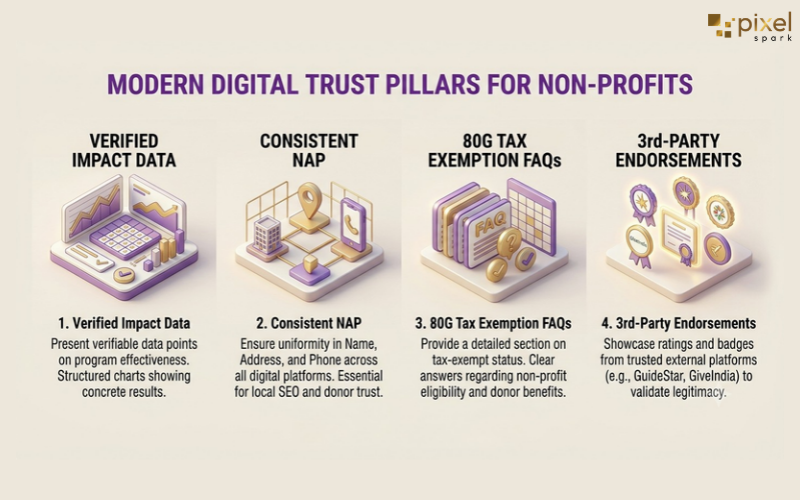
Here are the steps that genuinely help:
Build Clear Impact Pages
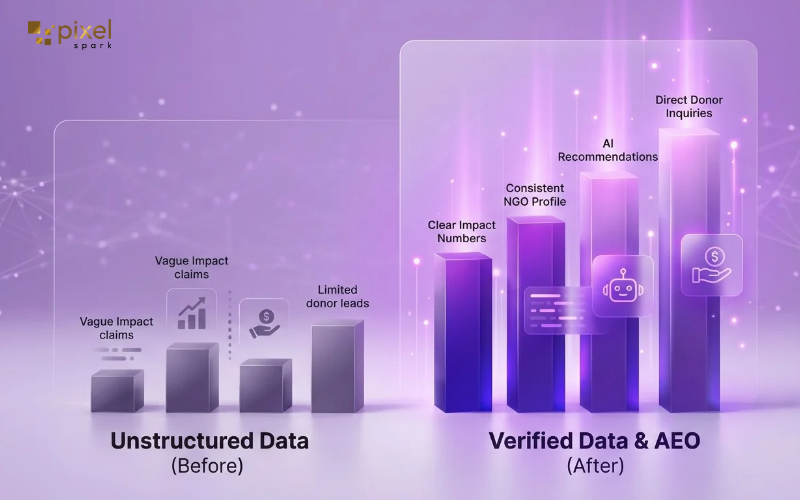
Do not just say “we help children.” Say how many children, in which districts, and what exactly changed for them. Numbers and specifics are what AI tools quote most often.
Keep Your NGO Details Consistent Everywhere
Your NGO’s name, registration details, address and contact information should match exactly across your website, Google, social media, and listing platforms like GuideStar India or Give India. Mismatched details confuse AI tools and reduce trust.
Add an FAQ Page in Plain Language
Write real answers to real donor questions, such as “How is my donation used?” or “Is this NGO registered under 80G?” Clear, direct answers are easy for AI tools to pick up and quote.
Earn Mentions From Trusted Sources
Local news coverage, CSR partner mentions, and listings on respected donation platforms all build authority. AI tools lean on these outside mentions to judge if your NGO is genuine.
Show Proof, Not Just Promises
Annual reports, audited accounts, and photos with real captions all add credibility. This is the same E-E-A-T idea, Experience, Expertise, Authority and Trust, that search engines use, and AI tools follow a similar pattern.
Small case study:
| A water and sanitation NGO working across villages in Rajasthan came to Pixel Spark with a strong ground program but a weak, outdated website. We rebuilt their impact pages with clear numbers, added a donor FAQ page, and helped them get listed correctly on two major donation platforms.
Within four months, the NGO began appearing in AI answers when people searched for water project NGOs in Rajasthan. Their team told us this was the first time a donor mentioned finding them through an AI chat tool rather than Google or a reference. |
Is This Only for Big, Well-Known NGOs?
No. In fact, it is often easier for smaller NGOs. Large national NGOs already dominate normal Google search, but AI search visibility for NGOs in India is still a fairly open field. Very few organisations, big or small, have focused on it yet.
This means a mid-sized or local NGO with honest, well-organised information can appear in AI answers alongside, or even instead of, a much bigger name. Trust and clarity matter more here than size or budget.
When Should an NGO Start Working on This?
An NGO should start now if it already has a working website, some donor history, and real impact data to share. Waiting is risky, because once more NGOs catch on to AI search visibility, the competition will rise and the easy wins will disappear.
If your NGO’s website is very outdated or has no real content yet, it is better to first build a simple, honest website. After that, AI search work becomes far more effective.
Conclusion
AI search visibility for NGOs in India is still a new and open space. Donors, especially younger and first-time donors, are already asking tools like ChatGPT and Perplexity for charity recommendations, and most NGOs have no presence there at all.
This gap will not stay open forever, but today it gives honest, well-organised NGOs a rare chance to stand out without competing against big budgets.
At Pixel Spark, we have worked with several NGOs across India to build this kind of visibility, from clear impact pages to consistent listings and donor-focused FAQs.
We do not promise overnight results, because donor trust is built slowly and carefully. But we do bring a clear plan, honest reporting, and real experience with how AI tools read and recommend nonprofit organisations.
If you want to know where your NGO stands today, reach out to Pixel Spark for a free AI search visibility check.
Frequently Asked Questions (FAQ)
1. What is AI search visibility for NGOs?
AI search visibility for NGOs means how easily tools like ChatGPT, Perplexity and Google Gemini can find, understand and recommend an NGO when someone asks a related question. It depends on clear website content, consistent details across platforms, and proof of real impact.
2. How do donors research NGOs before giving in India?
Donors in India research NGOs through Google search, social media, word of mouth, and increasingly, AI chat tools like ChatGPT and Perplexity. Many now use AI tools to shortlist two or three NGOs before checking their websites and deciding where to give.
3. What is answer engine optimization for nonprofits?
Answer engine optimization for nonprofits is the practice of structuring an NGO’s online information, such as impact data, FAQs and donor proof, so that AI tools can easily read, trust and quote it in their answers. It works alongside traditional SEO rather than replacing it.
4. How can an NGO get listed on ChatGPT results?
An NGO can improve its chances of appearing in ChatGPT results by publishing clear impact pages with real numbers, keeping its name and details consistent everywhere, adding an honest donor FAQ page, and earning mentions on trusted news sites and donation platforms.
5. Is AI search visibility only useful for large NGOs?
No. Smaller and mid-sized NGOs often find it easier, because large NGOs already dominate normal search while AI search is still a fairly open field. Clear, honest information matters more here than size or budget.