-
By Gunjan Gupta
- In Uncategorized
Overview
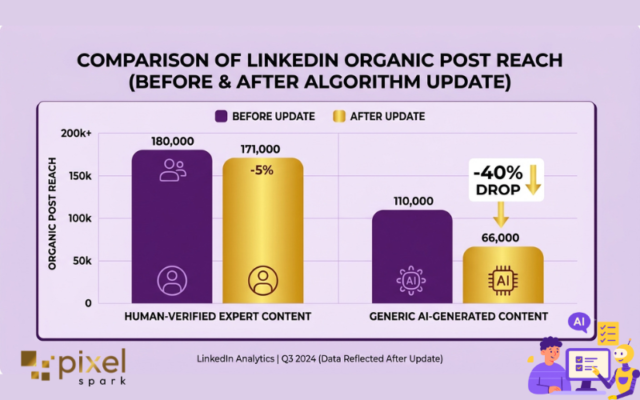
LinkedIn has updated its algorithm to suppress “AI slop” generic, low-effort AI-generated posts and comments, instead of removing them outright. Flagged content stays visible to direct connections but loses reach across the wider network, with some posts seeing up to 40% fewer views.
A new “Seems like AI slop” reporting button and smarter detection classifiers back up the change.
The message for marketers is simple: AI tools are still welcome, but only when paired with real expertise and original perspective. This guide breaks down what changed and how to keep your content performing.
LinkedIn Is Cracking Down on AI Slop: What It Means for Your Content Strategy
By Gunjan Gupta. 5mins read
If your LinkedIn posts have been getting fewer views lately, you’re not imagining it. LinkedIn has rewritten its algorithm to push down low-quality, AI-generated content and the results are already visible in creators’ analytics dashboards.
For anyone using AI content marketing or LinkedIn marketing strategy to grow a personal brand or business page, this is a shift you cannot afford to ignore.
In this read, we are sharing: what changed, why it happened, and how you can keep your content performing well without abandoning AI tools altogether.
Why LinkedIn Is Suddenly Fighting AI-Generated Content
LinkedIn built this problem itself. Over the past few years, the platform baked AI writing assistants directly into its posting tools, making it effortless for anyone to generate a polished-sounding update in seconds.
The result was a feed flooded with generic, forgettable posts that all start to sound the same.
Very vague motivational stories, recycled career advice, and hollow “thought leadership” with no real substance behind it.
Industry data backs this up.
Studies from AI-detection company Pangram Labs found that a large share of long-form LinkedIn posts show clear signs of being fully AI-written, with short-form posts not far behind.
Content creation on the platform has also grown significantly year over year, driven largely by AI-assisted posting rather than genuine human insight.
LinkedIn’s own leadership has acknowledged the problem publicly.
Hari Srinivasan, the company’s chief product officer, called tackling AI slop a “top priority” for the platform, noting that people come to LinkedIn to connect with real professionals and hear real perspectives, not machine-generated filler.
What Exactly Is Being Suppressed?
LinkedIn’s updated detection systems now target three specific categories of content:
- Generic AI-generated posts that lack any original perspective, personal experience, or unique expertise.
- Bot-generated or templated AI comments that add nothing meaningful to a conversation.
- Automation tools used to mass-produce AI content or artificially inflate engagement.
Importantly, this isn’t a ban. Flagged posts aren’t deleted. They simply lose reach. They remain visible to your direct connections and existing followers, but LinkedIn’s recommendation engine stops actively distributing them to the wider network.
For brands relying on organic reach to build visibility, that’s a serious loss.
The “Seems Like AI Slop” Button
To reinforce its algorithmic changes, LinkedIn also rolled out a user-facing reporting feature: a “Seems like AI slop” option available under the three-dot menu on any post or comment.
Within the first few weeks of launch, users clicked it more than a million times, according to figures shared by LinkedIn’s product team.
This crowdsourced signal works alongside automated detection. LinkedIn has clarified that no single report determines how a post is distributed. The system weighs many signals together, and safeguards exist to prevent people from misusing the button to target others unfairly.
Still, LinkedIn has confirmed that content flagged by its classifiers is seeing noticeably fewer views, in some cases a drop of around 40 percent.
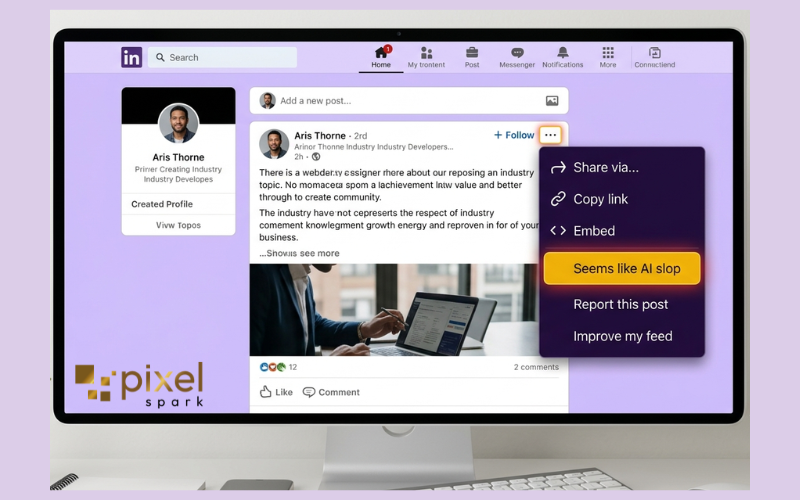
Alongside the button, LinkedIn quietly retired its built-in “enhance your post” AI writing feature, the very tool that made it easy to generate slop in the first place and replaced it with a simple proofreading assistant that improves grammar and clarity without rewriting your voice or ideas.
This Isn’t Just a LinkedIn Problem
LinkedIn is part of a broader industry trend. Newsletter platform Substack recently partnered with an AI-detection company to help readers identify machine-written content.
Snapchat has stopped recommending fully AI-generated videos through its discovery feed. Even Merriam-Webster named “slop” its word of the year, reflecting just how widespread the frustration with low-effort AI content has become across the internet.
The takeaway is clear: platforms are recalibrating to reward authenticity, and content marketing trends are shifting away from AI-generated quantity toward human-verified quality.
How to Protect Your LinkedIn Reach Going Forward
The good news is that LinkedIn isn’t punishing AI use itself, it’s only punishing laziness. Posts that combine AI efficiency with genuine expertise and a distinct point of view are still welcome, and brands that get this balance right stand to gain a real distribution advantage as competitors get suppressed.
Here’s how to stay on the right side of the algorithm.
1. Lead With Original Experience, Not Generic Advice
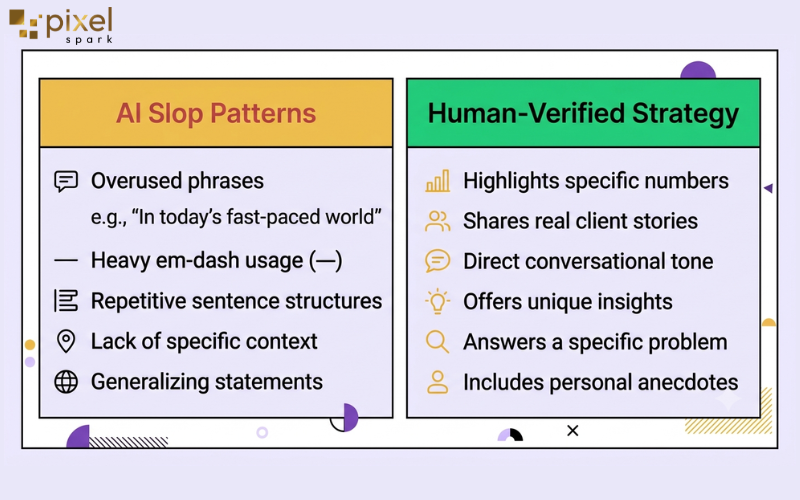
Generic AI output tends to state obvious truths in a confident tone. Instead, write from your own work: a specific client situation, a mistake you made, a number or result you can share. Specificity is the single easiest way to signal you’re not producing slop.
2. Use AI as an Editor, Not an Author
Rather than pasting a prompt into a chatbot and publishing whatever comes back, draft your own ideas first, even messily and use AI tools only to tighten grammar, structure, or flow. This mirrors exactly what LinkedIn’s own “enhance your post” replacement now does.
3. Learn to Spot Common AI Writing Patterns
Certain phrasing patterns have become giveaways of AI-generated text: overly balanced “on one hand, on the other hand” structures, excessive use of em-dashes, generic openers like “In today’s fast-paced world,” and conclusions that summarize rather than add value. Editing these out manually makes your writing sound more human immediately.
4. Engage With Real Comments, Not Templated Ones
Bot-style comments, vague praise, copy-pasted responses, or engagement-pod replies are directly targeted by LinkedIn’s new classifiers. Take the extra minute to write a comment that responds to the actual content of a post.
5. Build E-E-A-T Into Every Post
Search engines and social algorithms increasingly reward content that demonstrates Experience, Expertise, Authoritativeness, and Trustworthiness (E-E-A-T).
On LinkedIn, this means showing your work: cite real data, name real projects, share outcomes you personally achieved, and avoid vague generalizations that could have been written about anyone, by anyone.
6. Avoid Automation Tools for Content Scaling
If you’re using bots or scheduling tools to auto-generate and mass-publish AI content across multiple accounts, stop. LinkedIn has confirmed it’s blocking hundreds of thousands of automated comment attempts daily and billions of other automation attempts over just a few months. These accounts are increasingly easy to detect and penalize.
7. Monitor Your Analytics for Distribution Drops
LinkedIn is rolling out dashboard messages to help creators understand how their content is being received and whether it’s being classified as low-quality. Keep an eye on sudden reach drops, they may indicate your content style needs adjusting, even if engagement from existing followers looks normal.
What This Means for Businesses and Marketers
For brands using LinkedIn as part of a social media marketing strategy, this shift changes the calculus around AI-assisted content creation. Scaling content purely through automation is no longer a viable growth tactic and may actively work against you.
Instead, marketing teams should treat AI as a productivity tool that supports subject-matter experts, not a replacement for them.
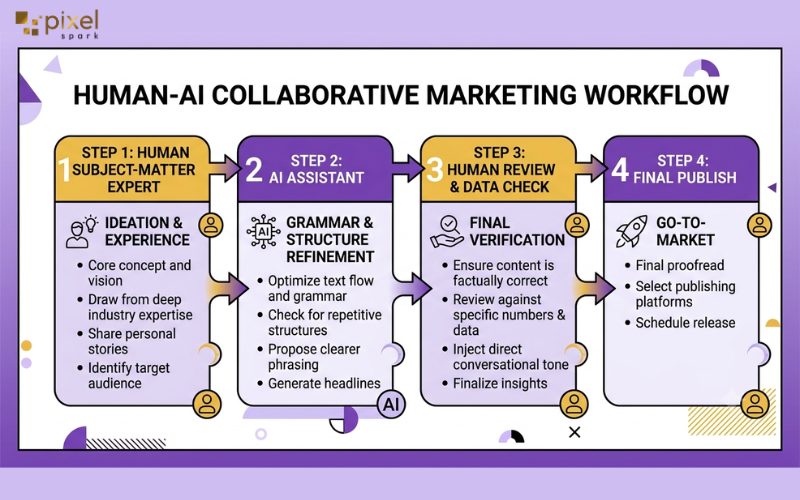
Practical steps for teams include:
- Assigning real employees, not just AI tools, to draft posts based on their genuine expertise.
- Using AI primarily for editing, repurposing, and formatting, not first-draft ideation.
- Prioritizing fewer, higher-quality posts over high-volume publishing schedules.
- Training team members to recognize and eliminate AI-sounding phrasing before publishing.
The Bigger Picture
LinkedIn’s crackdown reflects a maturing understanding across the tech industry: AI can help people communicate better, but it cannot replace genuine expertise, lived experience, or authentic perspective. Audiences (along with algorithms) are getting better at telling the difference.
As detection tools improve and platforms continue rewarding originality, the businesses and creators who invest in authentic, expert-driven content now will be the ones who benefit most from organic reach later.
At Pixelspark, we help brands build content strategies that blend AI-powered efficiency with real human insight: the exact combination LinkedIn’s algorithm is now rewarding. If you’re rethinking your LinkedIn or content marketing approach in light of these changes, our team can help you create a strategy built for long-term visibility, not short-term shortcuts.
Frequently Asked Questions (FAQ)
What is LinkedIn’s AI slop crackdown?
+
It’s an algorithm update where LinkedIn suppresses the reach of generic, low-quality AI-generated posts and comments instead of deleting them, limiting their visibility to a user’s immediate network only.
Will AI-generated posts be removed from LinkedIn?
+
No. Flagged posts remain visible to your direct connections and followers, but LinkedIn’s recommendation engine stops distributing them to the broader network.
Can you still use AI to write LinkedIn posts in 2026?
+
Yes. LinkedIn allows AI-assisted content as long as it includes original perspective, genuine expertise, or a meaningful personal contribution, not generic, templated writing.
How does LinkedIn detect AI-generated content?
+
LinkedIn uses automated classifiers combined with user reports from its “Seems like AI slop” button, claiming around 94% accuracy in identifying generic AI content.